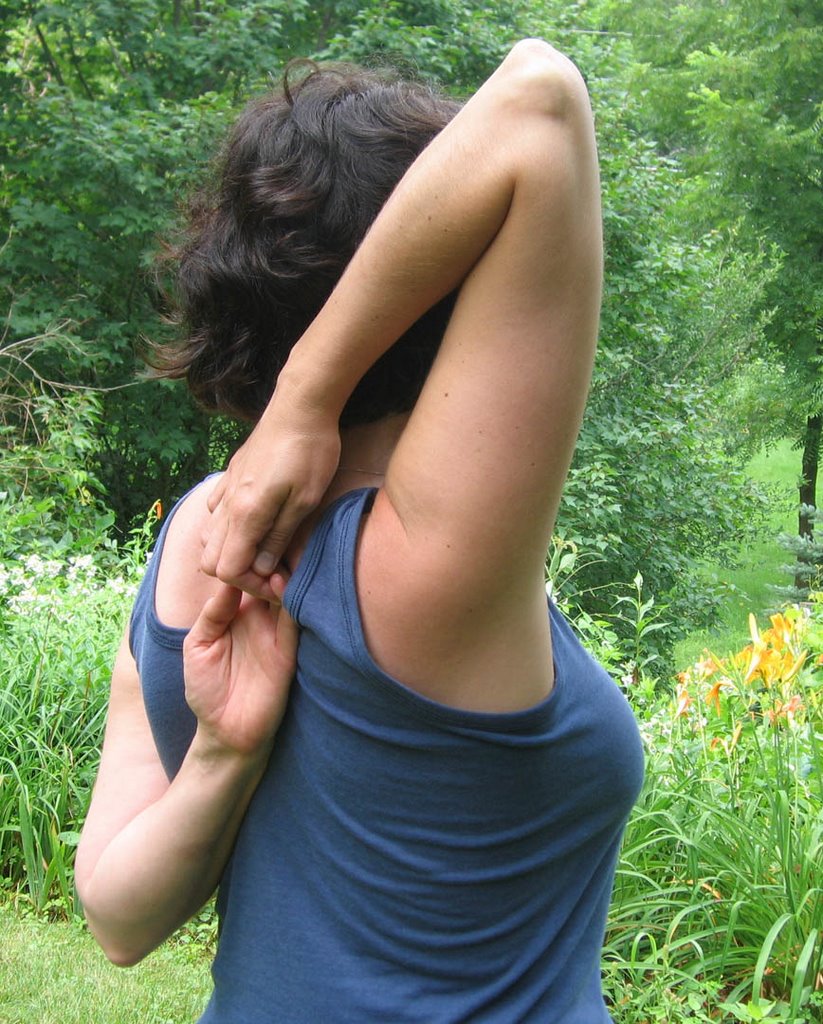
I had a great conversation with Jane Austin last nite. She is a prenatal yoga teacher and childbirth educator at YogaTree in San Francisco, and I was interviewing her for the teaching for pregnancy series I'm writing for My Yoga Mentor. What a hoot; if you are in the area and can either take a class or do a teacher training with her, I recommend it. She was funny, smart, earthy and would be such a comfort as a teacher or midwife (past occupation).
I was asking her about how to discouraging pregnant students from overdoing it and how to assure them that work was happening, even if muscles weren't screaming and sweat wasn't pouring. She says she asks students to consider why they need to have their yoga practice feel hard to be challenging. What is it about approaching yoga that way that puffs up the ego, while a quiet, focused practice feels wimpy or a cop-out.
The more I got to thinking about that, the more it seemed appropriate to ask about anyone's practice. Or anyone's approach to life, for that matter. Why does it need to be hard and crazy and jam-packed to seem like it "counts." Why can't it be fun or simple or enjoyable? Why can't the to-do list be short enough to actually finish? I know I'm guilty of such thoughts with myself, even though I find it so frustrating when students think nothing is happening in an "easy" class.
Is it the Puritan heritage of this country? Work hard for salvation? Idle hands are the devil's tools? A clear mind is scary? Whatever it is, I think just taking a moment to ask Why of the urge to add more to an over-scheduled plate is a good idea. Stop the ego dead in its tracks and give yourself a chance to breathe. I'll bet nothing bad will happen. I'll bet it will actually be kind of nice.
Thanks, Jane!
Thursday, March 20, 2008

Tuesday, March 11, 2008
I'll tell you mine, if you tell me yours...
After my last post about Down Dog, I got a number of comments from teachers who liked my instruction to line the wrist crease up with the mat to keep the arms aligned. This got me to thinking about other instructions I use, that I've found particularly useful. Some are ones I've borrowed from other teachers because they resonated with me, others I just discovered along the way. I love when a certain set up or phrase helps students discover a pose or gets them aligned, without any adjustment, just the words.
So, I thought, how about sharing. I'll post a couple of my favorite verbal cues and you send me yours. We can all benefit from everyone's experience and maybe we'll get a few more lovely Trikonasana out of our students just from the sounds of our voices!
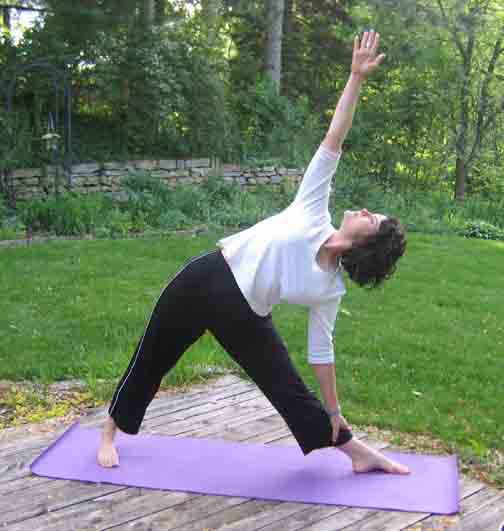
My trick for getting an aligned Trikonasana
One instruction I borrowed from a Yoga Journal article is to do seated twists in three parts over three breaths. During the first exhale you focus on twisting the lower back ("twist the belly button toward the right knee"), which is a small twist but gets the student to think about the base. The second breath moves up to the rib cage ("twist the breast bone to face the right knee"). The third breath is for twisting the shoulders. You can add a twist to the neck, at that point, if you like. This approach keeps the focus moving up the spine from the least flexible part of the spine--the lumbar--to the most flexible--the cervical. It makes for a much deeper twist, and a more thorough one.
Actually,it is good in any pose that includes a twist, not just seated poses, because it keeps the student's awareness in the spine and that extra length allows them to really lift the side ribs and work the muscles of the back. It also prevents them from just twisting at the neck and shoulders, so the whole back benefits from the pose. If you are doing a forward bend, it helps deepen the bend because the spine stays long and opens up space at the hip joint.
When you apply it to Trikonasana (Triangle), not only does it help the student think about lengthening the spine and opening the chest, but it also seems to stabilize the pelvis, so the hips open, too. Very rarely do I need to remind people to roll the back thigh out or keep the back hip lifted to prevent the pelvis from tipping forward, which is so common. It seems like a really cool trick, since I'm not even mentioning the legs. It is especially effective towards the end of class if we've been focusing on doing twists this way.
So, now it's your turn. What reminders or suggestions to find to be most effective? I'm all for some new ideas for spring (it's almost spring, right?)!

So, I thought, how about sharing. I'll post a couple of my favorite verbal cues and you send me yours. We can all benefit from everyone's experience and maybe we'll get a few more lovely Trikonasana out of our students just from the sounds of our voices!
My trick for getting an aligned Trikonasana
One instruction I borrowed from a Yoga Journal article is to do seated twists in three parts over three breaths. During the first exhale you focus on twisting the lower back ("twist the belly button toward the right knee"), which is a small twist but gets the student to think about the base. The second breath moves up to the rib cage ("twist the breast bone to face the right knee"). The third breath is for twisting the shoulders. You can add a twist to the neck, at that point, if you like. This approach keeps the focus moving up the spine from the least flexible part of the spine--the lumbar--to the most flexible--the cervical. It makes for a much deeper twist, and a more thorough one.
Actually,it is good in any pose that includes a twist, not just seated poses, because it keeps the student's awareness in the spine and that extra length allows them to really lift the side ribs and work the muscles of the back. It also prevents them from just twisting at the neck and shoulders, so the whole back benefits from the pose. If you are doing a forward bend, it helps deepen the bend because the spine stays long and opens up space at the hip joint.
When you apply it to Trikonasana (Triangle), not only does it help the student think about lengthening the spine and opening the chest, but it also seems to stabilize the pelvis, so the hips open, too. Very rarely do I need to remind people to roll the back thigh out or keep the back hip lifted to prevent the pelvis from tipping forward, which is so common. It seems like a really cool trick, since I'm not even mentioning the legs. It is especially effective towards the end of class if we've been focusing on doing twists this way.
So, now it's your turn. What reminders or suggestions to find to be most effective? I'm all for some new ideas for spring (it's almost spring, right?)!
Friday, February 29, 2008
Reconsidering the Wrists
I was cruising around to various yoga blogs this evening, looking for inspiration for this week's post. I'm trying to visit everyone regularly (new Xmas laptop does wonders for the screen time) and see what's going on. There's so much out there these days; it's exciting to see how each blog deals with the subject differently. Namaste from Duluth had an extensive discussion of Down Dog, that got me thinking about one of my favorite instructions for that pose.
 I thought I had talked about this before in an earlier post on wrists, but after a leisurely scroll down memory lane, I realized I hadn't. My teacher used to instruct us to place our hands so that the wrist crease was parallel to the top edge of the mat to prevent the elbows from hyper-extending. I never realized why that helped until I did the reading for that earlier post. By lining the wrists up, you "square" the insertions of the radius and ulna of the lower arm. When they are crossed (elbow creases thrust forward) the elbows lock and you end up holding the pose by resting the bones against each other, instead of using the muscles of the chest. Sort of the same logic behind engaging the thigh muscles in Trikonasa or Virabhadrasana II so that the knees don't lock and make the pose rigid.
Give it a try for either Urdhva or Adho Mukha Svanasana, various arm balances or Plank. It is much harder to hold these poses when the bones are un-locked; therefore strengthening the pectorals and biceps (which is gentler on the wrists).
I think my students often wonder why so much time is spent arranging the hands and arms for Dog. But once they are up, they notice the difference in the work of the torso (I hope) and it gives them a focus for the arms. I've also been sliding a rolled blanket under their heels if they are quite far off the floor to give them some support so they can lengthen behind the knees...but that is a discussion for another post.
P.S. I highly advise a glance at old posts. Like flipping thru a photo album, it's fun to reminisce about what inspired a certain article or what you were thinking when you had to rant (or rave). I wrote my 100th post a few weeks ago and forgot to commemorate it...looking back is an acknowledgement of all that work. Whew.
 I thought I had talked about this before in an earlier post on wrists, but after a leisurely scroll down memory lane, I realized I hadn't. My teacher used to instruct us to place our hands so that the wrist crease was parallel to the top edge of the mat to prevent the elbows from hyper-extending. I never realized why that helped until I did the reading for that earlier post. By lining the wrists up, you "square" the insertions of the radius and ulna of the lower arm. When they are crossed (elbow creases thrust forward) the elbows lock and you end up holding the pose by resting the bones against each other, instead of using the muscles of the chest. Sort of the same logic behind engaging the thigh muscles in Trikonasa or Virabhadrasana II so that the knees don't lock and make the pose rigid.
Give it a try for either Urdhva or Adho Mukha Svanasana, various arm balances or Plank. It is much harder to hold these poses when the bones are un-locked; therefore strengthening the pectorals and biceps (which is gentler on the wrists).
I think my students often wonder why so much time is spent arranging the hands and arms for Dog. But once they are up, they notice the difference in the work of the torso (I hope) and it gives them a focus for the arms. I've also been sliding a rolled blanket under their heels if they are quite far off the floor to give them some support so they can lengthen behind the knees...but that is a discussion for another post.
P.S. I highly advise a glance at old posts. Like flipping thru a photo album, it's fun to reminisce about what inspired a certain article or what you were thinking when you had to rant (or rave). I wrote my 100th post a few weeks ago and forgot to commemorate it...looking back is an acknowledgement of all that work. Whew.
Saturday, February 23, 2008
Some more Excellence
Oh yeah, I still have to finish my E for Excellence list. Here it is:
Yoga Like Salt
Yoga Dogs and Chocolate
Everyday Yogini
E for Enjoy!
Yoga Like Salt
Yoga Dogs and Chocolate
Everyday Yogini
E for Enjoy!
Friday, February 22, 2008
Yoga of Motherhood
When I was pregnant I thought a lot about yoga beyond asana, especially in the final trimester when my practice was mostly Baddha Konasana and pranayama. Frankly, asana is the easy part. Once you start to realize the opportunities for greater awareness and appreciation in the activities of your every day life (Yoga of Teaching, Yoga of Blogging, etc), you realize almost everything can become a practice if you decide to be engaged and respectful. It certainly makes everything count (see Jon Kabat-Zinn's practice of Mindfulness).
 I have two sons, 3 1/2 years and 6 months old. They are the loves of my life (after their dad) and--I'll tell ya--the hardest yoga exercise I've ever done. There is so much about motherhood that you have to practice vairagya (non-attachment) with, but one of the biggest things you have to let go of is your feelings about time. Everything is going too fast or not going fast enough.
 I have two sons, 3 1/2 years and 6 months old. They are the loves of my life (after their dad) and--I'll tell ya--the hardest yoga exercise I've ever done. There is so much about motherhood that you have to practice vairagya (non-attachment) with, but one of the biggest things you have to let go of is your feelings about time. Everything is going too fast or not going fast enough.
The baby is about to retire his car seat-basket and move into an upright chair--no more grocery shopping or going out for lunch while he sleeps. And he just had his first bite of sweet potato tonite. So I get excited to see him turn into a little kid and sit up straight and use a spoon. But I get wistful when I clean off the old car seat and get ready to put it away forever or imagine the day when breast milk is no longer his main source of nutrition. I can't wait until he sleeps through the nite (oh Lord, I can't wait), but I love letting him nap in my lap.
I felt much the same way with his older brother, although I was pretty sure I would get a second chance to celebrate all these developmental milestones with kid #2.
So I try to enjoy the process as it unfolds and not wish away any of difficult parts of their childhood. Or mourn the passing of the sweet babyish habits that fade with each new month. It is very hard and challenging but, as I've been saying, I'm not dead yet so I must be stronger.
In retrospect, Side-Plank, never seemed easier.
Wednesday, February 13, 2008
Russian Ballet Teacher
A few posts ago, jensmith98, asked for some thoughts about teaching a non-prenatal class while pregnant. Well, I have some thoughts so I'm gonna share them...
I taught through most of both pregnancies (stopping at the beginning of the 7th month for Eamonn, at the end of the 8th month for Alec). Because I teach an Iyengar-inspired style, it wasn't too hard to lead the class, with some minor modifications to lying-down poses to avoid pressure on the inferior vena cava (the large vein that carries de-oxygenated blood from the lower body--i.e.uterus--to the heart) To modify these, I used a bolster for Supta Padangusthasana (Hand-to-Big-Toe), Supta Baddha Konasana (Reclined Bound Angle), and Viparita Karani (Legs-up-the-Wall), so I was reclined at about a 30-degree angle. I usually just led the final relaxation verbally, while seated, altho a few times I did recline on my left side with supports.
I avoided most inversions and all backbends and front-lying poses. I did Adho Mukha Svanasana (Down Dog) pretty late into the pregnancy, altho after awhile it just didn't feel very good, so I did a Half Dog, with my hands on a chair or countertop (which felt great to shift the weight off my lower abdominals and lower back).
As I got bigger, I stopped doing demos and had more experienced students show the correct form. It also allowed me to show adjustments on them, so that the rest of the class could see better positioning for the pose. By the eighth month I stopped waddling around the classroom and did most of my adjustments verbally. I joked that I was going to teach like a old Russian ballet teacher--seated in a chair at the front of the room, tapping students with my cane when they were in the wrong position.
Most of all, I tried to be respectful of what my body was telling me as far as what I could and couldn't do. A lot of poses felt just fine, other stuff just felt weird. I felt a little silly parking in a chair at the front of the room part of the time, but it took so much effort to get on and off the floor that it was easier to do my perambulations from a seat. I hope I was a good example to my students as far as recognizing my limitations and working with them, rather than pretending they didn't exist (impossible to do when you are big as a house, I might add).
My own practice became much less physical towards the end, but I think the time I spent in Supta Baddha Konasana focusing on my breath really helped when it came time for labor and delivery (I only had to push for about 7 min.s, when Alec was born); I could really focus and stay calm despite the pain and how weird the whole process is.I was lucky in that both pregnancies were very low-maintenance, so I could keep up with my yoga. I'm glad I was able to stay involved with my classes and students for so long, because I think it kept me from focusing too much on the discomfort of the third trimester. Once I got used to my bulk (sort of), it was kind of fun to be the representative Pregnant Yogi.
So, it worked for me and I don't think my students minded the change in teaching style. At least my classes stayed the same size and everyone came back after my maternity leave. My message to jensmith98 is: teach for as long as you can, find the ability to laugh at your limitations and enjoy the attention. I loved teaching pregnant and I think the lesson of listening to your body is good for all of us, not just the mommies.
Those of you that taught during your pregnancies...do you have anything to add, suggest?
I taught through most of both pregnancies (stopping at the beginning of the 7th month for Eamonn, at the end of the 8th month for Alec). Because I teach an Iyengar-inspired style, it wasn't too hard to lead the class, with some minor modifications to lying-down poses to avoid pressure on the inferior vena cava (the large vein that carries de-oxygenated blood from the lower body--i.e.uterus--to the heart) To modify these, I used a bolster for Supta Padangusthasana (Hand-to-Big-Toe), Supta Baddha Konasana (Reclined Bound Angle), and Viparita Karani (Legs-up-the-Wall), so I was reclined at about a 30-degree angle. I usually just led the final relaxation verbally, while seated, altho a few times I did recline on my left side with supports.
I avoided most inversions and all backbends and front-lying poses. I did Adho Mukha Svanasana (Down Dog) pretty late into the pregnancy, altho after awhile it just didn't feel very good, so I did a Half Dog, with my hands on a chair or countertop (which felt great to shift the weight off my lower abdominals and lower back).
As I got bigger, I stopped doing demos and had more experienced students show the correct form. It also allowed me to show adjustments on them, so that the rest of the class could see better positioning for the pose. By the eighth month I stopped waddling around the classroom and did most of my adjustments verbally. I joked that I was going to teach like a old Russian ballet teacher--seated in a chair at the front of the room, tapping students with my cane when they were in the wrong position.
Most of all, I tried to be respectful of what my body was telling me as far as what I could and couldn't do. A lot of poses felt just fine, other stuff just felt weird. I felt a little silly parking in a chair at the front of the room part of the time, but it took so much effort to get on and off the floor that it was easier to do my perambulations from a seat. I hope I was a good example to my students as far as recognizing my limitations and working with them, rather than pretending they didn't exist (impossible to do when you are big as a house, I might add).
My own practice became much less physical towards the end, but I think the time I spent in Supta Baddha Konasana focusing on my breath really helped when it came time for labor and delivery (I only had to push for about 7 min.s, when Alec was born); I could really focus and stay calm despite the pain and how weird the whole process is.I was lucky in that both pregnancies were very low-maintenance, so I could keep up with my yoga. I'm glad I was able to stay involved with my classes and students for so long, because I think it kept me from focusing too much on the discomfort of the third trimester. Once I got used to my bulk (sort of), it was kind of fun to be the representative Pregnant Yogi.
So, it worked for me and I don't think my students minded the change in teaching style. At least my classes stayed the same size and everyone came back after my maternity leave. My message to jensmith98 is: teach for as long as you can, find the ability to laugh at your limitations and enjoy the attention. I loved teaching pregnant and I think the lesson of listening to your body is good for all of us, not just the mommies.
Those of you that taught during your pregnancies...do you have anything to add, suggest?
Friday, February 08, 2008
E is for Excellent
Yoga Mama has sent out a challenge of sorts...name your top 10 favorite blogs, and they--in turn--have to name theirs. Sort of a blogo-chain letter. I have been meaning to acknowledge a number of blogs that I like and bloggers who have made some interesting comments on GTTSB, so here's my opportunity. Here's my list so far,in no particular order...I have two more to go, but I also have to hit they hay if I want to get any sleep before the first feed of the nite. Ah, the baby trumps yoga (and blogging) as usual...
-YogaPulse
-YogaPulse
-Just Breathe
-Yoga and Cupcakes
-Yoga Dawg
Friday, February 01, 2008
A Woman's Intuition
So, the research continues. I had a really interesting conversation with Judith Lasater on Wednesday for this prenatal yoga series I'm writing. She has always been one of my yoga heroes--physical therapist, religion Ph.D, smart, sensible, good writer--so I was excited about the prospect of our conversation. Unfortunately, I was a bit tongue-tied, as well. I had come up with a few prenatal questions (appropriate poses for which trimester, etc), but, as we talked, I realized they were woefully basic and didn't take advantage of her expertise.
Luckily, Judith didn't let the interview peter out and offered her own approach to the subject. Of the many things we talked about (the yogic tradition and its lack of prenatal tradition, learning to relax, learning to teach relaxing), one of my favorite was acknowledging one's intution and learning to trust it. What a simple but complex idea!
How do you teach some one to trust the work that their body is doing and that it will provide you (your mind?) and the baby with the support it needs when the time comes? How do you teach some one to relinquish control, while allowing her body to do the heavy lifting? Judith talked about letting students acknowledge their feelings while in a pose ("If you like it, stay longer. If it is uncomfortable, come out of it.") and letting them take charge of their own practice. It seems like a subject that needs its whole own article.
I'm also reading Gurmukh's Bountiful, Beautiful, Blissful book (I'm hoping to interview her, too), and this is a theme she comes back to over and over again, as well. It reminds me of my discussions about non-attachment (vairagya) for the Ego article this summer. Intriguing, crucial and very, very difficult to teach (and practice!).
So, tell me. How do you teach some one to trust herself and the power her body has. How do you teach yourself? It's definitely something I need to work on. I suppose it there's any practice that teaches you not to cling to things that don't matter, it's motherhood (my floors are mighty gritty these days)!
Luckily, Judith didn't let the interview peter out and offered her own approach to the subject. Of the many things we talked about (the yogic tradition and its lack of prenatal tradition, learning to relax, learning to teach relaxing), one of my favorite was acknowledging one's intution and learning to trust it. What a simple but complex idea!
How do you teach some one to trust the work that their body is doing and that it will provide you (your mind?) and the baby with the support it needs when the time comes? How do you teach some one to relinquish control, while allowing her body to do the heavy lifting? Judith talked about letting students acknowledge their feelings while in a pose ("If you like it, stay longer. If it is uncomfortable, come out of it.") and letting them take charge of their own practice. It seems like a subject that needs its whole own article.
I'm also reading Gurmukh's Bountiful, Beautiful, Blissful book (I'm hoping to interview her, too), and this is a theme she comes back to over and over again, as well. It reminds me of my discussions about non-attachment (vairagya) for the Ego article this summer. Intriguing, crucial and very, very difficult to teach (and practice!).
So, tell me. How do you teach some one to trust herself and the power her body has. How do you teach yourself? It's definitely something I need to work on. I suppose it there's any practice that teaches you not to cling to things that don't matter, it's motherhood (my floors are mighty gritty these days)!
Wednesday, January 23, 2008
Yoga and The Belly
 Apparently, more than any other topic, the most popular questions on Yoga Journal's newsletter for teachers ("My Yoga Mentor") is how to deal with pregnant students in yoga class. So, my next series of articles for them will discuss how to make class as safe and useful as possible for pregnant yoginis. This is not to be a replacement for specific study of prenatal yoga, but more an introduction into key concerns and essential modifications.
On the one hand, it seems pretty basic--one article per trimester, describe useful poses, warn about contraindicated poses--but it also is kind of overwhelming. Where to start? Having just finished my second pregnancy (and having taught the whole way through), I feel pretty in tune to the limitations of the pregnant body. But, I have no idea what it feels like to wander into your first yoga class, 7 months pregnant, where everyone else is regulars and not pregnant. I feel like these are the students that the article should address, but--man--it seems like there are a lot of issues to cover. Any thoughts?
It is interesting how the practice shifts from asana to pranayama and meditation--at least it did for me. I'm going to interview the obstetric nurse who helped deliver both my sons and is now, coincidentally, one of my students. I'm really interested to hear what a professional thinks are the most useful elements of yoga for labor and delivery. Obviously breath and focus are important, but I suspect there is more.
So, I'm headed into the research part of the process and thought I would post my initial ideas to see what y'all think. So many of you are teachers and/or mothers with yoga experience, I'm sure you can give me some suggestions of what to consider (remember, I only have 750 words per article). I look forward to hearing from you!
(Boy, looking back at that picture from June...I gotta say, I do not miss those maternity fashions, that's for sure!)
Monday, January 14, 2008
Proprioception...
 Jane Brody had an interesting article in last week's NYT Science section on balance (Preserving a Fundamental Sense: Balance). It was mostly about what determines your sense of balace and some exercises to improve it(nothing about yoga, tho, hmph). She writes that there are three main sensory contributors to balance: vision, cilia in the inner ear, and proprioceptors on the bottom of the feet. These decline with age, but there are ways to maintain these elements through various balancing exercises.
I was intrigued by proprioceptors, since I had never heard of such of thing. According to Wikipedia it is "is a third distinct sensory modality that provides feedback solely on the status of the body internally. It is the sense that indicates whether the body is moving with required effort, as well as where the various parts of the body are located in relation to each other." Nerve receptors in the muscles send information to the brain so that it understands where the body is located in space without using visual information. This is how you can walk in the dark without falling over or, with a little practice, touch the tip of your nose with your index finger while your eyes are closed. Or type without looking at your fingers, or drive without seeing your feet on the pedals. Important stuff.
Like most motor skills, it is one that can be learned. So I thought I'd post a little exercise to bring awareness into the soles of the feet. Where you go from there is up to you...Vrksasana (Tree Pose), Garudasana (Eagle), Utthita Hasta Padangusthasana (Standing Hand-to-Big-Toe Pose). If you really want to challenge yourself, try them with your eyes closed!
Grounding Thru the Foot Bones
Stand in Tadasana (Mountain Pose). Lift all your toes at once, and feel the rest of the foot settle into your mat. Now lower just the big toes. Now lift the big toes and just lower the little toes. Now lower the big toes, but keep all the toes in between lifted. Is this easy or hard? You can help yourself a bit, by mimicking the actions of the toes with the fingers (I don't know why this helps, but it does). Now lower all toes, so that each one has its own space to settle and notice how much more solid your stance is.
I like to start all my standing poses with this exercise, just to get the feet grounded, but also to help make my toes more coordinated. I even try to drum my toes, little to big toe--one at a time--in imitation of my son. I notice my 3 1/2 year old has so much mobility in his toes, he could play the piano! I'm not looking to add more digits on the keyboard, but I suspect that drummable toes equals well-tuned proprioceptors.
Ankle and leg strength also play an important part in your ability to balance. But the sole of the foot is the starting point. Give it a try and see!
Tuesday, January 08, 2008
Still herding...
Happy New Year, all! I hope you rang it in with a group of dear ones. We hit the hay about 9:45pm and I noted the transition when I was up again to feed the babe at midnight. Ah the glamorous festivities of early motherhood. Altho, I can say I rang it in with my nearest and dearest...(champagne glass half full).
I hope you've had a chance to look at all the comments about the last post (Herding Cats), there are some really thoughtful responses. I'm still thinking about the subject--not obsessing, mind you--and I've had a couple of ideas. How about a general test that would be taken after you'd finished your training, wherever you studied--like the accounting or bar exam. It would cover general yoga knowlegde--maybe the same categories as the YA certification--and ought to include some sort of demonstration of your teaching abilities (adjustments, modification, general classroom manner, etc) that would be evaluated by a senior teacher. Instead of placing emphasis on where you studied, it would measure what you actually know and can teach.
This could be the basic Hatha test...if students wanted to continue on to a more advanced study of Iyengar, Ashtanga, Kripalu, etc., that could be an additional credential to the basic test. By creating a measurement that would assess everyone's skills evenly, I think it would more fairly identify who should be teaching and who shouldn't. And, I suppose, you wouldn't have to take the test to teach, but any organization that wanted to be assured of your expertise could require it.
It's a huge undertaking, of course. What would be on the test? Who would score it? What would be the criteria for assessing the teaching demonstration? Where would it happen? How often? What is required for a passing "grade"? etc. etc. On the other hand, maybe there needs to be something this standardized to help level the playing field of all the different trainings. Instead of trying to cobble together something from lots of disparate sources, you could just say you passed the Hatha test with flying colors.
I, for one, would be relieved to have something that measured my yoga knowledge and my ability to present it effectively. Assuming I would pass the test, of course...
Chew on that one for awhile, and let me know what you think!
I hope you've had a chance to look at all the comments about the last post (Herding Cats), there are some really thoughtful responses. I'm still thinking about the subject--not obsessing, mind you--and I've had a couple of ideas. How about a general test that would be taken after you'd finished your training, wherever you studied--like the accounting or bar exam. It would cover general yoga knowlegde--maybe the same categories as the YA certification--and ought to include some sort of demonstration of your teaching abilities (adjustments, modification, general classroom manner, etc) that would be evaluated by a senior teacher. Instead of placing emphasis on where you studied, it would measure what you actually know and can teach.
This could be the basic Hatha test...if students wanted to continue on to a more advanced study of Iyengar, Ashtanga, Kripalu, etc., that could be an additional credential to the basic test. By creating a measurement that would assess everyone's skills evenly, I think it would more fairly identify who should be teaching and who shouldn't. And, I suppose, you wouldn't have to take the test to teach, but any organization that wanted to be assured of your expertise could require it.
It's a huge undertaking, of course. What would be on the test? Who would score it? What would be the criteria for assessing the teaching demonstration? Where would it happen? How often? What is required for a passing "grade"? etc. etc. On the other hand, maybe there needs to be something this standardized to help level the playing field of all the different trainings. Instead of trying to cobble together something from lots of disparate sources, you could just say you passed the Hatha test with flying colors.
I, for one, would be relieved to have something that measured my yoga knowledge and my ability to present it effectively. Assuming I would pass the test, of course...
Chew on that one for awhile, and let me know what you think!
Sunday, December 16, 2007
As Simple as Herding Cats
I'm in the process of applying for another teaching gig at a new "wellness center" that has opened in the Stateline area. It's affiliated with Beloit Memorial Hospital and has a whole wing with doctors' offices and physical therapy, in addition to a very swank gym, pool and studios (Pilates and yoga have separate rooms). There will be some overlap from my students at the Y, but also a lot of new folks from Northern Illinois.
I've hit a snag. Because of the medical aspect, they want to make sure all the instructors are well-trained and certified. The certified part works well for the aerobics teaching and trainers, because of the rigor with which ACE, etc. keeps track of their teachers. They are having some trouble with the yoga teachers' credentials, tho--especially me.
I had a very intense training period with my teacher in DC and spent every other Saturday for a year at her house studying poses--how to teach, how to modify, how to sequence them. I also did some (not a lot) of student teaching at her studio and she observed some of my teaching. So, I think I had a good grounding (ha) in the basics and have tried to stay current with various workshops, etc. when I can get to Madison or other yoga conferences. For what it's worth, my students seem to be happy with my teaching. But none of this is work towards a specific Certification...and none of it is with Yoga Alliance members (altho I have studied with Iyengar, Kripalu, Ashtanga, etc. teachers), so I can't count towards a R.Y.T. designation. There are 5 YA-approved schools in Wisconsin and the nearest one to me is in Milwaukee (80 min. drive each way), so I can't really start over from scratch.
It's made me think about yoga teacher training in this country and how to organize (if that's possible) all the different styles and approaches so that outsiders can measure how qualified a teacher is. This is a huge debate in the yoga community--and while the Yoga Alliance has the right idea--I'm not sure it's possible to gather all of us under one governing body. And maybe we don't want one governing body, but how to assess the quality of different trainings? And is teaching yoga in a multi-purpose facility, such as a gym, less legitimate than in a studio? And consider the possibility of including yoga in a wellness plan that insurance companies would be willing to support, how would they measure its effectiveness? How about those of us who practice and teach in communities without a large yoga network?
I'm not sure how it will go with North Pointe (the aforementioned wellness center). I hope I can cobble together a resume that they approve of, but we'll see. In the mean time, what do all of you think of this subject and how have you dealt with the issue of multiple trainings/quality of trainings/lack of certification/etc? Any ideas?
How do you herd a group of cats and keep them in the corral...
I've hit a snag. Because of the medical aspect, they want to make sure all the instructors are well-trained and certified. The certified part works well for the aerobics teaching and trainers, because of the rigor with which ACE, etc. keeps track of their teachers. They are having some trouble with the yoga teachers' credentials, tho--especially me.
I had a very intense training period with my teacher in DC and spent every other Saturday for a year at her house studying poses--how to teach, how to modify, how to sequence them. I also did some (not a lot) of student teaching at her studio and she observed some of my teaching. So, I think I had a good grounding (ha) in the basics and have tried to stay current with various workshops, etc. when I can get to Madison or other yoga conferences. For what it's worth, my students seem to be happy with my teaching. But none of this is work towards a specific Certification...and none of it is with Yoga Alliance members (altho I have studied with Iyengar, Kripalu, Ashtanga, etc. teachers), so I can't count towards a R.Y.T. designation. There are 5 YA-approved schools in Wisconsin and the nearest one to me is in Milwaukee (80 min. drive each way), so I can't really start over from scratch.
It's made me think about yoga teacher training in this country and how to organize (if that's possible) all the different styles and approaches so that outsiders can measure how qualified a teacher is. This is a huge debate in the yoga community--and while the Yoga Alliance has the right idea--I'm not sure it's possible to gather all of us under one governing body. And maybe we don't want one governing body, but how to assess the quality of different trainings? And is teaching yoga in a multi-purpose facility, such as a gym, less legitimate than in a studio? And consider the possibility of including yoga in a wellness plan that insurance companies would be willing to support, how would they measure its effectiveness? How about those of us who practice and teach in communities without a large yoga network?
I'm not sure how it will go with North Pointe (the aforementioned wellness center). I hope I can cobble together a resume that they approve of, but we'll see. In the mean time, what do all of you think of this subject and how have you dealt with the issue of multiple trainings/quality of trainings/lack of certification/etc? Any ideas?
How do you herd a group of cats and keep them in the corral...
Monday, December 03, 2007
Don't Think, Just Do...Parivritta Janu Sirsasana
In the interest of maintaining some sort of home practice, I'm going to put up a single pose each week for you (and me!) to drop into. Preferably there would be some sort of lead-in and some sort of follow-up, but 5-10 mins. of yoga is better than nothing at all. I'm not advocating headstands without any warm-up, obviously, but most of the standard poses will still give you a nice stretch in the moment. Maybe some time, in the not too distant future, I can have my own practice, again. Sigh.

Parivritta Janu Sirsasana (Revolved Head-to-Knee Pose)
1 . Begin in Dandasana (Staff Pose) with the spine long and aligned. Then slide the left knee to the side and, using both hands, gently roll the shin and top of the foot towards the floor. Try and line your heel up with the center of your perineum, but don’t loose the length in the lower back. Extend the left leg to the side so that your legs make a 90-degree angle. Keep the left big toe and knee pointed towards the ceiling.
2. Sit tall and concentrate on lifting the side ribs and lining the shoulders up with the hips. Start twisting to the right (towards the bent knee), concentrating the twist in the lumbar spine.

Parivritta Janu Sirsasana (Revolved Head-to-Knee Pose)
1 . Begin in Dandasana (Staff Pose) with the spine long and aligned. Then slide the left knee to the side and, using both hands, gently roll the shin and top of the foot towards the floor. Try and line your heel up with the center of your perineum, but don’t loose the length in the lower back. Extend the left leg to the side so that your legs make a 90-degree angle. Keep the left big toe and knee pointed towards the ceiling.
2. Sit tall and concentrate on lifting the side ribs and lining the shoulders up with the hips. Start twisting to the right (towards the bent knee), concentrating the twist in the lumbar spine.
Tuesday, November 27, 2007
Playing With Yoga
Between turkey, colds, stomach viruses and writing another article for My Yoga Mentor (Yoga Journal's online newsletter for teachers), GTTSB took a pretty big hit. Sorry it's been awhile.
The article had the working title "Playing with Yoga" and was inspired by a Sept. 2007 YJ article called "More Fun." It was about various yoga hybrids out there (Acro-yog--acrobatics and yoga; trance dance; slack-line yoga--yoga on a tightrope) and I thought it might be interesting to talk to some of these people and see what advice they had for teachers. I was also a bit skeptical, since I wonder how much this kind of combining dilutes the original practice.
I've been convinced, however. I heartily agree with Yoga Dawg that a lot of the yoga community takes itself waaay too seriously. Playing around with asana is nothing new (where would Iyengar yoga be, if B.K.S. hadn't developed all his modifications) and being light-hearted with the results makes it all a bit more palatable to our Western hearts. As I see it, whatever makes it compelling and helps you practice more should be celebrated. It is a testament to the discipline that it can handle all these variations and still deliver strength, flexibility and calm to its practitioners.
I really liked what Leah Kalish of YogaEd had to say about setting a context for asana when teaching to kids. She trains teachers to create an environment where kids are empowered by learning the mind-body connection; they do art projects (make a "centering box" filled with things that help you feel calm and in control), create music (what does good balancing music sound like?), play games and do yoga. I like the idea of creating a context for asana, so that the class has a theme, rather than just doing leg work or balancing poses. I think students of all ages respond well to this and it gives yoga a purpose and connects it to real life, which is very important to beginners.
 I usually organized my classes by what part of the body is being focussed on and discuss how the physiology of the body responds to various asana (hip openers open hips, obviously, but also open up the lower back so that ending the class with some gentle twists might be the logical progression from Baddha Konasana, for example). But maybe something even broader might be interesting...what happens to the shoulders when you focus on thighs, how do high energy poses lead to greater calmness, etc. Or maybe even something silly, like how does 70s soul affect the practice (I'm not sure I have the guts to try that out in the classroom, but one of my best home practices ever was to Barry White and the Love Unlimited Orchestra).
What do you think about yoga hybrids and playing with yoga? Do you or don't you? I'm all ears...
The article had the working title "Playing with Yoga" and was inspired by a Sept. 2007 YJ article called "More Fun." It was about various yoga hybrids out there (Acro-yog--acrobatics and yoga; trance dance; slack-line yoga--yoga on a tightrope) and I thought it might be interesting to talk to some of these people and see what advice they had for teachers. I was also a bit skeptical, since I wonder how much this kind of combining dilutes the original practice.
I've been convinced, however. I heartily agree with Yoga Dawg that a lot of the yoga community takes itself waaay too seriously. Playing around with asana is nothing new (where would Iyengar yoga be, if B.K.S. hadn't developed all his modifications) and being light-hearted with the results makes it all a bit more palatable to our Western hearts. As I see it, whatever makes it compelling and helps you practice more should be celebrated. It is a testament to the discipline that it can handle all these variations and still deliver strength, flexibility and calm to its practitioners.
I really liked what Leah Kalish of YogaEd had to say about setting a context for asana when teaching to kids. She trains teachers to create an environment where kids are empowered by learning the mind-body connection; they do art projects (make a "centering box" filled with things that help you feel calm and in control), create music (what does good balancing music sound like?), play games and do yoga. I like the idea of creating a context for asana, so that the class has a theme, rather than just doing leg work or balancing poses. I think students of all ages respond well to this and it gives yoga a purpose and connects it to real life, which is very important to beginners.
 I usually organized my classes by what part of the body is being focussed on and discuss how the physiology of the body responds to various asana (hip openers open hips, obviously, but also open up the lower back so that ending the class with some gentle twists might be the logical progression from Baddha Konasana, for example). But maybe something even broader might be interesting...what happens to the shoulders when you focus on thighs, how do high energy poses lead to greater calmness, etc. Or maybe even something silly, like how does 70s soul affect the practice (I'm not sure I have the guts to try that out in the classroom, but one of my best home practices ever was to Barry White and the Love Unlimited Orchestra).
What do you think about yoga hybrids and playing with yoga? Do you or don't you? I'm all ears...
Sunday, November 04, 2007
Easing into it
Last week, after class, one of my newer students approached me after class asking what she could do to get into better "yoga shape." We had just finished an hour of hip openers and, while she was much more comfortable sitting in Sukhasana (easy pose) at the end of class, she felt worked over to the point that she was a bit sore. I suspect she was also frustrated with herself for not being able to do some of the poses that my regulars could do. I promised to think about good asana for a beginner to work on at home that would help increase flexibility, but also be easy to remember and pleasant to do. I thought some seated poses would be appropriate, because you can really focus on the alignment of the spine and pelvis--a crucial juncture in yoga.
 A nice way to bring awareness to the arms, legs and side body is a combination of Dandasana and Hastasana. (Staff Pose + Overhead Arm Stretch) Extend the legs out in front of you, pressing the soles of the feet away evenly and engaging the thigh muscles. Raise your arms to the side and keep the shoulders away from the ears as you lift your arms overhead. Interlock the fingers and turn the palms towards the ceiling. After your initial stretch, bend the elbows slightly and let your palms come further back to deepen the rotation in the shoulder joints. Try to straighten the arms.
Another of version of this stretch is Upavistha Konasana (Seated Wide-Angle Pose). It will work on the hip joints and inner thighs, so lift yourself on a couple of blankets, if you can't keep your lower back long. Extend the legs out to the sides, but only so far that you can keep your toes and knees pointed to the ceiling. Lift the side ribs and lengthen the spine. Stretch your arms towards the ceiling to get extra length in the torso. Start folding forwards from the hip joints as you stretch the arms out…don’t collapse the chest and keep the spine long. Lower the arms but continue to lengthen the side ribs as you fold a bit deeper.

“Loop” breathing Pay attention to the beginning and end of each breath. Notice how much “silence” there is at the end of each inhale and exhale; the moment when there is no breath at all. On the next cycle, try to imagine your breath as a loop and let the exhale begin as soon as the inhale finishes, so there is no stopping. This will be a bit jerky at first, especially between the exhale and inhale (it is easier to let full lungs empty than to begin filling them again). Imagine the cycle as an oval, with the transitional points at each end and visualize the breath moving smoothly around those curves during the transition. Continue this for a while (5-10 mins.) and then let your breath return to its normal pattern.
Of course, there are lots of other beginning poses you can work, but I think this short series is good at increasing awareness of length in the spine and the work of the hips and legs. What asana do you think are good places to start, when easing into a yoga practice?
Thursday, November 01, 2007
15-Second Vacation
Take a look (as the Iyengars say) at Jenn's comment from "Getting Back on Track". She has attached an excerpt from a great article about the lessons of early motherhood. It is very pertinent to my frame of mind these days and is a nice set up for my thoughts in this post.
The lad and I are coming off a vicious yeast infection (for me), mild thrush infection (for him) which has made nursing excruciating. I have been using every breathing and pain management technique I can think of to get through this (the Sleeping Master has been refusing bottles, lately). Throw in a three-year-old who is tired of sharing his parents' attentions ("Any attention is good attention...I'm going to start throwing my cars") and things have been a bit dreary around here.
So I've been falling back on a trick called "15-second vacation" a friend from grad school used to do. Polly would whip out a picture of some lovely vacation spot and imagine herself there for a quarter-minute to try and get out of the academic grind. I've been trying it with any sensory experience that is pleasurable...relaxing in the steam of a hot shower, reclining onto the support of a foam-topped mattress (before the next 2 hr. "nap" of the night), working my way through a left-over Halloween peanut butter cup, feeling my spine unclench during a quick Uttanasana. It's like a Mindfulness exercise, but I figure I've got to grab the peaceful moments while I can and be satisfied with 15-seconds. Most of the time it works.
I remember an episode from "Fraiser," where Fraiser's dad is berating the psychiatrist for being so neurotic. He gestures towards Eddie, his ratty-looking terrier, who is rolling on the floor and announces, "You know, Fraiser, you could take a lesson from Eddie. You know what makes him happy, an old sock!" I think about that sometimes and try to let the simple things make me happy...if all it takes is an old sock, I have a whole drawer of happiness in the bedroom.
I hope you find 15-seconds today to enjoy your old sock...

The lad and I are coming off a vicious yeast infection (for me), mild thrush infection (for him) which has made nursing excruciating. I have been using every breathing and pain management technique I can think of to get through this (the Sleeping Master has been refusing bottles, lately). Throw in a three-year-old who is tired of sharing his parents' attentions ("Any attention is good attention...I'm going to start throwing my cars") and things have been a bit dreary around here.
So I've been falling back on a trick called "15-second vacation" a friend from grad school used to do. Polly would whip out a picture of some lovely vacation spot and imagine herself there for a quarter-minute to try and get out of the academic grind. I've been trying it with any sensory experience that is pleasurable...relaxing in the steam of a hot shower, reclining onto the support of a foam-topped mattress (before the next 2 hr. "nap" of the night), working my way through a left-over Halloween peanut butter cup, feeling my spine unclench during a quick Uttanasana. It's like a Mindfulness exercise, but I figure I've got to grab the peaceful moments while I can and be satisfied with 15-seconds. Most of the time it works.
I remember an episode from "Fraiser," where Fraiser's dad is berating the psychiatrist for being so neurotic. He gestures towards Eddie, his ratty-looking terrier, who is rolling on the floor and announces, "You know, Fraiser, you could take a lesson from Eddie. You know what makes him happy, an old sock!" I think about that sometimes and try to let the simple things make me happy...if all it takes is an old sock, I have a whole drawer of happiness in the bedroom.
I hope you find 15-seconds today to enjoy your old sock...

Monday, October 22, 2007
Secrets of Sequencing (Part Two)
I sort of left you hanging last week, with only the upper part of your body warmed and stretched. Here is the post that followed "Secrets, Part One." Now we’re ready to address the lower back and legs, which are the main supporters of all the standing poses (i.e. Trikonasana-triangle pose, Virabhadrasana-warrior poses, etc.).
A good place to start bringing awareness to the large muscles of the legs is Dandasana (Staff pose). The pose is relatively simple, sitting with the spine aligned and the legs extended, but an engaged Staff gets blood flowing into the legs and energizes the torso with the effort it takes to sit tall and ground through the back of the legs. If you combine it with an arm stretch (Hastasana-overhead arm stretch, for example) it becomes a very active way to work most of the muscles at once.
©Brenda K. Plakans. All Rights Reserved.
Sunday, October 14, 2007
Secrets of Sequencing...redux
Well, the life of a householder--especially one with two little kids--does not leave much time to blog. Or do anything else. I am starting teaching this week and have been thinking about what sort of classes to prepare after my maternity leave. I went back into the "archives" to see what I said about sequencing last summer, and this is what I found...
Secrets of Sequencing, part One (revised)
One of, if not the, best part of taking a yoga class is letting yourself be lead through a series of poses that progress logically so that by the end of the session your body is completely worked and refreshed. An asana sequence is most successful when it teaches you the various elements of your target pose, but lets each step of the way challenge your body to stretch and open to its fullest. When you reach the peak of the class, your muscles and limbs naturally accept the challenge of the headstand, backbend, etc. because they have been properly prepared.
As you become more familiar with the many of positions in hatha yoga, you will begin to see the connections between them and this will help you develop your home practice. However, until all the Sanskrit names become second nature to you, I want to suggest ways of linking warm-ups and poses so you can start sequencing on your own. Even if you read this blog to get ready-made home practice sequences, you can use this information for a quick “spot stretch” --to loosen a cramped shoulder or stretch a tight calf muscle.
Try and start with a short meditation, or few minutes of focused breathing. This can be while you are standing in Tadasana (Mountain) or sitting comfortably cross-legged in Sukhasana (Easy Pose). Let your mind release, focus on the breath and take some time to align and open the spine.
From the breath and the spine, move your attention into your upper body. Consider what your target pose is going to be and think about what you need to prepare. Backbends and Shoulder Stands need warmed shoulder joints and an open chest. Headstands need energized arms and a long spine. Standing balance poses need a lifted rib cage and squared hips. Evaluate the work of the asana and what muscles are most engaged (what is sore when you finish the pose?) and work backwards to what preparations warm and stretch those parts of the body.
Hastasana (overhead arm stretch) is always a good place to start, because you get the whole torso into the act. The shoulder joints are intensely rotated, the sides of the chest stretch to keep the spine long and the hips have to balance to keep the tailbone pointing to the floor. This stretch can happen while you are standing or in Virasana (Hero), Dandasana (Staff) or Sukhasana. Make sure to keep the neck relaxed, the shoulders away from the ears and breathe evenly. Another option is using the arm position from Gomukhasana (Cow’s Head). This requires even more rotation in the shoulder joints, while it stretches the triceps in the upper arms and opens the chest. Try to focus on the opening of the shoulder joints and keep the neck and upper back relaxed. Also, keep the spine long and the lower back neutrally curved; it’s easy to arch when you are so focused on the arms. The arm position for Garudasana (Eagle Pose) also opens the shoulders and upper chest, but moves the stretch to the center back as the arms twist at the center front.
If Cow’s Head and Eagle are too pretzel-y for you, the Namaste hand position in back, also opens the chest and rotates the shoulders more gently. Work to deepen the stretch in the armpits by keeping the neck long and stretching the elbows down and back, as you press your palms together behind the shoulder blades. Keep your breath even, but notice the extra stretch you can sneak in by filling the lungs and lifting the rib cage on your inhales. Tricky.
Now the upper body is warm and open. You can come back Sukhasana and notice how you feel, compared to when you started. Store those observations because they will help you remember what stretch affects which muscles. This information is what will help you decide how to sequence your practice.
Next time, I’ll continue onto the hips and legs so you can develop well-rounded sequences. Until then, keep these warm-ups in mind during your next yoga class and notice which ones are echoed in the more difficult poses. And enjoy letting your teacher do the heavy thinking…
[Goodness, I was rather formal last year. You can also check out Yoga Journal's new Sequence Builder on their website...it takes a bit of time to download, but it has good descriptions, pictures and you can share your sequences with other yogis]
Secrets of Sequencing, part One (revised)
One of, if not the, best part of taking a yoga class is letting yourself be lead through a series of poses that progress logically so that by the end of the session your body is completely worked and refreshed. An asana sequence is most successful when it teaches you the various elements of your target pose, but lets each step of the way challenge your body to stretch and open to its fullest. When you reach the peak of the class, your muscles and limbs naturally accept the challenge of the headstand, backbend, etc. because they have been properly prepared.
As you become more familiar with the many of positions in hatha yoga, you will begin to see the connections between them and this will help you develop your home practice. However, until all the Sanskrit names become second nature to you, I want to suggest ways of linking warm-ups and poses so you can start sequencing on your own. Even if you read this blog to get ready-made home practice sequences, you can use this information for a quick “spot stretch” --to loosen a cramped shoulder or stretch a tight calf muscle.
Try and start with a short meditation, or few minutes of focused breathing. This can be while you are standing in Tadasana (Mountain) or sitting comfortably cross-legged in Sukhasana (Easy Pose). Let your mind release, focus on the breath and take some time to align and open the spine.
From the breath and the spine, move your attention into your upper body. Consider what your target pose is going to be and think about what you need to prepare. Backbends and Shoulder Stands need warmed shoulder joints and an open chest. Headstands need energized arms and a long spine. Standing balance poses need a lifted rib cage and squared hips. Evaluate the work of the asana and what muscles are most engaged (what is sore when you finish the pose?) and work backwards to what preparations warm and stretch those parts of the body.
Hastasana (overhead arm stretch) is always a good place to start, because you get the whole torso into the act. The shoulder joints are intensely rotated, the sides of the chest stretch to keep the spine long and the hips have to balance to keep the tailbone pointing to the floor. This stretch can happen while you are standing or in Virasana (Hero), Dandasana (Staff) or Sukhasana. Make sure to keep the neck relaxed, the shoulders away from the ears and breathe evenly. Another option is using the arm position from Gomukhasana (Cow’s Head). This requires even more rotation in the shoulder joints, while it stretches the triceps in the upper arms and opens the chest. Try to focus on the opening of the shoulder joints and keep the neck and upper back relaxed. Also, keep the spine long and the lower back neutrally curved; it’s easy to arch when you are so focused on the arms. The arm position for Garudasana (Eagle Pose) also opens the shoulders and upper chest, but moves the stretch to the center back as the arms twist at the center front.
If Cow’s Head and Eagle are too pretzel-y for you, the Namaste hand position in back, also opens the chest and rotates the shoulders more gently. Work to deepen the stretch in the armpits by keeping the neck long and stretching the elbows down and back, as you press your palms together behind the shoulder blades. Keep your breath even, but notice the extra stretch you can sneak in by filling the lungs and lifting the rib cage on your inhales. Tricky.
Now the upper body is warm and open. You can come back Sukhasana and notice how you feel, compared to when you started. Store those observations because they will help you remember what stretch affects which muscles. This information is what will help you decide how to sequence your practice.
Next time, I’ll continue onto the hips and legs so you can develop well-rounded sequences. Until then, keep these warm-ups in mind during your next yoga class and notice which ones are echoed in the more difficult poses. And enjoy letting your teacher do the heavy thinking…
[Goodness, I was rather formal last year. You can also check out Yoga Journal's new Sequence Builder on their website...it takes a bit of time to download, but it has good descriptions, pictures and you can share your sequences with other yogis]
Monday, October 01, 2007
On Becoming Yourself...

The Vicomtesse Marie-Laure de Noailles, a French patroness of 1930's Surrealist poets and painters, used to ask new friends the question, "At what age did you become yourself?" (for more on her read this abstract of an article in the September 24 issue of The New Yorker) I think she was doing it to be witty and unpredictable , but I find the question is a fascinating one to mull over. What are the most affecting events of your life and how did they shape the "final" (if there is such a thing) product? Finding a partner? Leaving home? Having kids? Studying yoga?
The last question may seem a bit of a stretch, but I suspect it might have more to do with your answer than you think (I know it does for me). Once you start a regular yoga practice, you start to notice some of the "noise" begins to slip away and you find yourself stronger, less stressed, even happier. I think I became myself around age 32 or 33. I moved to Washington DC from Los Angeles to be closer to my partner (now husband) and began working at the Washington Opera as a costumer. It was the first time in years that I had a steady gig (versus free-lance stuff) and the security of a regular paycheck was very comforting. I also began attending a weekly yoga class with the teacher I eventually trained with. All of these elements combined to make me feel very settled and centered and I think that's when a lot of the grad-school insecurity and unfocused energy of my 20s began to dissipate.
Of course, motherhood means a new phase has started, but a lot of the habits and traits that were established in DC have helped me juggle the challenges of parenthood. The combo of teaching and writing about yoga and chasing little kids around has made me even more focused (you can only get done what really has to get done) and able to let the pesky stuff go ignored. So, I guess you could say I've been "myself" for about 8 years.
How about you...when did you become yourself? Did yoga have anything to do with it? Can you really put a date on something like this? If nothing else, you have an ice-breaker for your next cocktail party...
Monday, September 24, 2007
Getting Back on Track
Well, the babe is officially four weeks old today. Sleeping and eating times seem to be settling into a routine, but I'm still having trouble imagining myself back up at the front of the yoga classroom in three weeks. Despite having practiced (and taught) into the eighth month of the pregnancy, I still feel like I have a ways to go to get back into shape. I've been trying to come up with a good "re-entry" practice that is gentle, but still strength-building, to lead up to a regular series of standing poses, etc. Here's what I've come up with, so far:
Gentle Abdominals
 Obviously, everything in my torso is out of wack, so I'm working on sitting poses that require a lengthened spine. Sukhasana (Easy Pose) is an obvious one, but Dandasana (Staff Pose) is proving quite challenging not only to my middle, but also to the fronts of the thighs. Keeping the legs extended and engaged is not so easy and when you add the work required to lift the side ribs and open the chest, there is a lot going on. I try to include Hastasana in both seated poses, to get the shoulders open and engaged.
Chest/ Spine Openers
Although it wasn't a problem during pregnancy, with all the hunching over a wee one, my upper back is killing me. So, I've included some chest openers in my practice to counter my urge to slump forwards. A good pose for this, is Viparita Karani (Legs-Up-The-Wall pose). This is an inverted, more supported version of Staff, with the added bonus of releasing the lower back. I've added a gentle stretch to the backs of the legs by lifting one leg at a time away from the wall (sort of a Supta Pandangustasana --Hand-to-Big-Toe). Stretching the arms overhead engages the shoulders and also opens the chest.
 Uttanasa (Intense forward bend) against the wall (feet about a foot or so away, bum resting on the wall, knees soft) is also a nice release for the back and stretches the backs of the legs as well. If I'm feeling especially open, I interlock my arms and let the added weight of the upper body deepen the stretch. A Seated Twist is also a nice way to stretch out the muscles on either side of the spine.
A great opener, but only if I've warmed up with all the others, is to just drape myself--face up--over my exercise ball. At first, I keep my arms at my sides but with each breath I try to move them up and out to the sides, letting the breath open the spine to allow the arm lifting. I also have to work on releasing my neck, but after this stretch I feel especially open and can feel the blood moving around my spine.
In addition to these restorative poses, I've been walking. It feels like I have a long way to go, but hopefully all of this will jog my muscles' memory and things will start coming back together. What about you all--have any of you had to come back to yoga after a long hiatus? What were your favorite poses to ease back with? If you teach, how do you help post-partum (or post-operative, etc) students adjust? I'd love to hear some other ideas for getting back on track...
Gentle Abdominals
 Obviously, everything in my torso is out of wack, so I'm working on sitting poses that require a lengthened spine. Sukhasana (Easy Pose) is an obvious one, but Dandasana (Staff Pose) is proving quite challenging not only to my middle, but also to the fronts of the thighs. Keeping the legs extended and engaged is not so easy and when you add the work required to lift the side ribs and open the chest, there is a lot going on. I try to include Hastasana in both seated poses, to get the shoulders open and engaged.
Chest/ Spine Openers
Although it wasn't a problem during pregnancy, with all the hunching over a wee one, my upper back is killing me. So, I've included some chest openers in my practice to counter my urge to slump forwards. A good pose for this, is Viparita Karani (Legs-Up-The-Wall pose). This is an inverted, more supported version of Staff, with the added bonus of releasing the lower back. I've added a gentle stretch to the backs of the legs by lifting one leg at a time away from the wall (sort of a Supta Pandangustasana --Hand-to-Big-Toe). Stretching the arms overhead engages the shoulders and also opens the chest.
 Uttanasa (Intense forward bend) against the wall (feet about a foot or so away, bum resting on the wall, knees soft) is also a nice release for the back and stretches the backs of the legs as well. If I'm feeling especially open, I interlock my arms and let the added weight of the upper body deepen the stretch. A Seated Twist is also a nice way to stretch out the muscles on either side of the spine.
A great opener, but only if I've warmed up with all the others, is to just drape myself--face up--over my exercise ball. At first, I keep my arms at my sides but with each breath I try to move them up and out to the sides, letting the breath open the spine to allow the arm lifting. I also have to work on releasing my neck, but after this stretch I feel especially open and can feel the blood moving around my spine.
In addition to these restorative poses, I've been walking. It feels like I have a long way to go, but hopefully all of this will jog my muscles' memory and things will start coming back together. What about you all--have any of you had to come back to yoga after a long hiatus? What were your favorite poses to ease back with? If you teach, how do you help post-partum (or post-operative, etc) students adjust? I'd love to hear some other ideas for getting back on track...
Tuesday, September 18, 2007
Your Ego and Your Teaching
Just a quick link to my latest article for Yoga Journal's My Yoga Mentor newsletter called "Your Ego and Your Teaching." (Check out their new website, especially the "Build Your Own Sequence" feature). The research and the interviews for this piece are what inspired the postings for the last month or so. It was very hard to condense it all into 750 words, so you got some of what I had to leave out. Even if you aren't a yoga teacher, there is some good advice for how to deal with one's inner control freak ("I put that woman down hours ago...").
Also, please be patient with my erratic posting these days. I am trying to juggle the responsibilities of mother-of-two-hood and, although I have a lot of help from my parents right now, I only have about a half an hour every night to do anything non-child related (which is usually taking a shower). Hopefully I'll get it together a bit more in a month or so and be more regular ("Don't hold your breath, sister," laughs all of you out there with two or more kids).
Cheers!
Also, please be patient with my erratic posting these days. I am trying to juggle the responsibilities of mother-of-two-hood and, although I have a lot of help from my parents right now, I only have about a half an hour every night to do anything non-child related (which is usually taking a shower). Hopefully I'll get it together a bit more in a month or so and be more regular ("Don't hold your breath, sister," laughs all of you out there with two or more kids).
Cheers!
Sunday, September 09, 2007
A Buddhist Thought...

For my three-year old's second birthday, I bought a book called Zen Shorts, by Jon J. Muth because I loved the watercolors. The story is very sweet--about a peaceful panda that moves into a neighborhood--but we never got through the book. Eamonn just wasn't interested in koan-spouting bears. However, lately he has been picking it as an early morning read, so I finally finished it. One of the panda's parables is so appropriate to all my vairagya discussions, I wanted to post it. Since I am one that tends to stew, it is especially useful...
A Heavy Load
Two traveling monks reached a town where there was a young woman waiting to step out of her sedan chair. The rains had made deep puddles and she couldn't step across without spoiling her silken robes. She stood there, looking very cross and impatient. She was scolding her attendants. They had nowhere to place the packages they held for her, so they couldn't help her across the puddle.
The younger monk noticed the woman, said nothing and walked by. The older monk quickly picked her up and put her on his back, transported her across the water, and put her down on the other side. She didn't thank the older man, she just shoved him out of the way and departed.
As they continued on their way, the young monk was brooding and preoccupied. After several hours, unable to hold his silence, he spoke out. "That woman back there was very selfish and rude, but you picked her up on your back and carried her! Then she didn't even thank you!"
"I set the woman down hours ago," the older monk replied. "Why are you still carrying her?"
Monday, September 03, 2007
My New Guru
I've been a bit lax in my posting lately, while I've finished up a project I've been working on for the last nine months. Alexander Scott was born Monday, August 27 at 5:17 in the afternoon. He was a good-sized 20 1/4", 7lb. 14 oz. guy. The delivery was quick and I owe much of the speed to ujayii breathing and the pranayama focus I've been practicing the last few months. That and some good-sized hips.
So, give me a week or so, and I'll be back in the game. Juggling a 3-yr-old and a baby ought to be good for all kinds of yoga thoughts and lessons...

So, give me a week or so, and I'll be back in the game. Juggling a 3-yr-old and a baby ought to be good for all kinds of yoga thoughts and lessons...

Thursday, August 23, 2007
Have a Look...
As you often hear in an Iyengar class--Have (or Take, depending on your teacher's first language) a Look. I have been reading a few new--to me--yoga blogs and there are several I think you will enjoy. There are some yogis with a nice sense of humor out there! Check them out:
Soul Jerky: YogaDawg-ish irony with lots of interesting links to yoga-related (sorta) articles, nice design
Isha Yoga: a snappy blog, with some very funny observations--most recently about nude yoga
Playin' the Edge: some nice observations about her own practice, quotes and sequencing ideas
Yoga, Dogs and Chocolate: a personal blog with topics ranging from yoga to vacation photos to reading lists
Yoga Buzz: Yoga Journal posts news from the yoga world...some of the discussions get quite heated
Let me know if you have any favorites that we should consider!
Soul Jerky: YogaDawg-ish irony with lots of interesting links to yoga-related (sorta) articles, nice design
Isha Yoga: a snappy blog, with some very funny observations--most recently about nude yoga
Playin' the Edge: some nice observations about her own practice, quotes and sequencing ideas
Yoga, Dogs and Chocolate: a personal blog with topics ranging from yoga to vacation photos to reading lists
Yoga Buzz: Yoga Journal posts news from the yoga world...some of the discussions get quite heated
Let me know if you have any favorites that we should consider!
Saturday, August 18, 2007
In Remembrance of Things Past...
Maybe I am just torturing myself, but I thought it might be nice to think about Plank and some variations for a few days. I haven't offered much in the way of Yoga Practice lately, and its always good to pay some attention to the core. Of course, I'm not doing anything abdominal right now--or maybe I am only doing abdominal work, depending how you look at it (the Youngster is due in 2 weeks)--but I am looking forward to the future.
Here's a little something to hold you (borrowed from last summer)...for the next post I want to talk about vairagya (non-attachment) again and will be back to more Thoughts.
Variations for Plank Pose
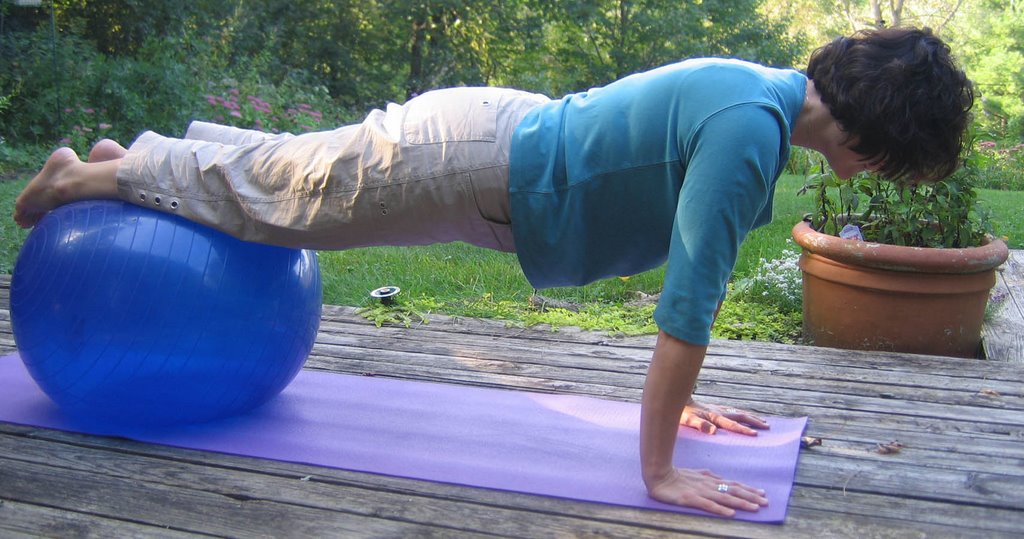
Basic Plank: Set up in Table Pose as you would for Dog; heels of the hands are beneath the shoulders, knees are beneath the hips. From here, straighten the arms and stretch the legs out behind to bring the torso into a straight line from the ankles to the shoulders. Keep the shoulders away from the ears and the neck long. Notice the work in the torso--the abdominals do most of the work in this pose, more than the arms and legs, because they are responsible for keeping the spine long and the torso lifted. If your hips sag, or the body is bent, lower one or both knees to the floor, so that the abs are still engaged, but you can lengthen the back. Try to hold for 5 breaths and work up to 10.

©Brenda K. Plakans. All Rights Reserved.
Monday, August 13, 2007
Blogging as a Yoga Practice
I’ve been a self-publisher from an early age. In fourth grade I put out a monthly newsletter call Brenda’s Bugle that featured such goodies as book reviews, 4-clue crossword puzzles, some cartoons cribbed from the New Yorker and a contest that my grandmother always won (I knew she wouldn’t collect the prize money—usually a dollar). There was also a two-issue modern dance “magazine” that I forced my sister to subscribe to and a fanzine some friends and I intended to start in high school, but just ended up borrowing some disks from the campus record store with the intension of reviewing them (I wrote the reviews but never got around to printing them…or returning the records).

Monday, August 06, 2007
Witnessing the Voices
Some interesting ideas have come up lately, both from my interviews for the “Ego and Teaching” article and in my readings on Pranayama. In the last couple of posts, I’ve been talking about other yoga practices besides asana, so I’m still thinking about that, too (so have some readers, check out the comments sections to see what Stella, Kristin and Gypsy Girl have offered about their non-asana practice).

Friday, August 03, 2007
Ego preview...
Whoa, have I been remiss. The combination of another Yoga Journal deadline looming and my 9th month low energy and resulted in a delay of blog posting. Sorry about that.
This all goes along with my current yoga-is-not-just-asana kick. So I have a lot more to say about expanding your yoga practice, but I need to do a bit more thinking. On Monday I'll start sharing these reflections.
Have a great weekend!
Subscribe to:
Posts (Atom)