...or is this whole combining motherhood and work thing getting out of hand?
I'm all for women doing fulfilling work and, lord knows, mothers need something for themselves--especially when kids are young (why do you think I started GTTSB?). But do we really want to encourage pregnant women to jet set around to meetings while their amniotic fluid is leaking? Or zipping back to work, only three days post-partum? It's bad enough that the womens' magazines trumpet losing baby-fat in a month...as if cellulite should be your biggest concern when the baby is 3 weeks old.
Give the body a rest, y'all. We don't expect Teddy Kennedy back in the Senate three days after his brain surgery... Does Sarah Palin really believe that the Alaska electorate is so heartless, that they wouldn't let her lie down for a couple of days? Are they? What's wrong with this country that it can't accept that pregnacy and delivery is one of the most traumatic things that will happen to a woman's body. Why do women (want to) pretend that it's just a quick in-and-out of the hospital and then, back-to-business.
Dirty-footprints had a nice post, cautioning about too much multi-tasking. You can't avoid some multi-tasking with a family--if you want everyone to eat and still get to bed in time for Mama to do some blogging--but it shouldn't drive you into a frenzy. I can almost hear the health insurance crowd foaming at the mouth to get new mothers out of the hospital in 24 hours. ("Still bleeding? Well, here's an adult diaper. Good luck!")
I practiced, and taught yoga, through my own two pregnancies and I think part of the reason everything went so well was that I cleared space for myself and listened to my body. I practiced pranayama every nite for the last two trimesters and stayed home for 6 weeks after both boys were born (very grateful for that opportunity, of course). I slowed it down, because my body had to slow down--shouldn't every mother allow herself to do that? Shouldn't every mother be able to?
Jeez, Sweden is looking better all the time...
Monday, September 08, 2008

Thursday, September 04, 2008
The Satisfaction of Sneering
The other night my mom asked me what I thought about the Republican vice-presidential candidate, Sarah Palin. I won't go into my full answer here--not really appropriate for a yoga blog--but I did say that she is some one who my crowd would have sneered at at our 20th High School reunion, three years ago. Being the know-it-all-journalism types, we wouldn't have approved of some one our age who tries to have library books banned.
 But it got me to thinking about the act of sneering and how satisfying it is. And how often it is practiced (especially in the anonymity of the blogosphere). And, also, how it really says more about the sneer-er than the sneer-ee.
Boy, there's a lot of it in yoga-land. Which yoga style is better/more effective/more sustainable; Yoga Journal's cover models; the yoga supers stars' overexposure; the fact that there are yoga super stars at all; studying in India or not; etc etc etc.
Even the gurus themselves aren't above a mighty rant about their "competitors." This was something I found extremely distasteful at a conference last year, when just about every presenter at a teachers' workshop felt inclined to point how much better "their" yoga was than the others. Only David Swenson and Ana Forrest skipped the Sneer--hmmm.
I won't pretend for a minute that I am above commenting on a scrawny model butchering natarajasana (Dancer Pose)in an ad for HardTail yoga pants (what kind of a name is that?) or online teacher-training certifications. Some stuff deserves a skeptical eye. Even so, it says more about my Ego and its need to establish superiority than it does about the things I find fault with. Sigh.
BTW, apparently a sneer is also a freshly poured beer (?), which is something we can all find satisfaction in.
Tuesday, September 02, 2008
Yoga at the Store
If you're local to the Stateline area, this post if for you. I'm offering Yoga and Supper at Bushel and Peck's Local Grocery on Sunday, September 14 from 3-5. I'll teach class (haven't decided the theme yet) for an hour and then we will enjoy a meal from the cafe, featuring locally-grown ingredients. We haven't decided the menu yet, either, but everything I've eaten there is delicious--any requests? I'll bring all the props, you bring your mat.
The class will be limited to 15 people and the cost will be $20. You can sign up on the BP's website or at the store at 328 State Street, Beloit or call 608/363-3911. Let me know if you have any questions!

The class will be limited to 15 people and the cost will be $20. You can sign up on the BP's website or at the store at 328 State Street, Beloit or call 608/363-3911. Let me know if you have any questions!

Tuesday, August 26, 2008
All of us are in the gutter...but some of us are looking at the stars
An interesting discussion is afoot on Linda's Yoga Journey, concerning the wages of yoga teachers. Are we paid too much? (hardly) not enough? (often) the same as aerobic instructors? (sometimes...but maybe we shouldn't). I've thought about it often, since I teach at the Y, where there are a variety of fitness classes offered alongside my yoga classes.
I think yoga teachers' fees ought to reflect their training. If you spend a year or two (or more) learning from a reputable source, your wage should be commeasurate. If you took an email test online and got "certified" in an afternoon--whatever that means--that lack of diligence should be acknowledged, too. Continued training ought to be rewarded, as well, but I suspect that is more rare. And, of course, there's the issue of market value...people pay more for yoga classes, so teachers can ask more (some chicken and egg at work).
The under-paid teacher complaint is an old one. Those that want to share their knowledge and expertise often have to take satisfaction in a job well-done as part of their renumeration, whether yoga instructors or college professors or kindergarden teachers. These are crucial positions, and vital to the improvement of a civilized population, but rarely is it rewarded as it should be. The world values lawyers, businessmen, movie stars and football players more.
As far as fitness goes, I'll bet it's the aerobic instructors that get the shaft, payment-wise, more than yoga teachers, tho. Maybe the training isn't as long, but the amount of prep that it takes to choreograph and learn the routines is time-consuming. A strong background in physiology isn't required, but there has to be some familiarity with how the body works and how you train it. And then there's the level of exersion necessary to serve up a useful, engaging class to a roomful of, perhaps, less-than enthusiastic participants. Cetainly worth more than minimum wage...
So, this is what I think about. I'm not sure I have an answer...life is not fair. I wish yoga teachers (most of them) made more money than than Lindsay Lohan. And people should want to invest in the instructors that help keep them hearty and hale. But they don't, so I suppose it's pointless to spend too much energy on it.
I read a quote that's pertinent: "Santosa (or contentment, one of the niyamas from the Yoga Sutras by Pantanjali) cannot be practiced; it has to come from within. We're all discontented. The trick is to be content with that."--B.K.S. Iyengar.
Friday, August 15, 2008
The Mind Games
I haven't been able to watch much Olympics (just swimming, yawn), but I've been reading about them. The amount of training these athletes go through is crazy (I'm not even going to touch on the pharmaceutical aspect), but what I find particularly interesting is the mental work they do to get themselves ready to compete. They train and lift and run for years, but right before the event it all comes down to the voices in their heads--either listening to them, or turning them off. I think that's fascinating, although, as a yoga teacher, I shouldn't be all that surprised.

There was a really interesting article in the New Yorker a few weeks ago about the brain chemistry behind inspiration and discoveries that come in an "aha" moment. Studies by several researchers found that a specific part of the brain in the right hemisphere becomes especially active about 30 seconds before the subjects had their moments, and that this fold of brain tissue communicates with the prefrontal cortex (the area of the brain that recognizes the problem has been solved); when a thought "just comes to you" the brain has actually been working on it for awhile. They found that this communication was especially efficient when they brain (and thinker) was relaxed and even thinking about something else when the connection was made. Think of all the times you figured something out or solved a problem when you were doing an unrelated task--that would be the relaxed mind at work.
I had an artist friend that used to put projects aside for a few days, when the creative juices stopped flowing--she called it "putting them on the back burner." She found that, upon returning to the projects after some time had passed, she was able to finish them to her satisfaction, as if the brain had unconsciously solved the problem while she was otherwise occupied. We used to joke about it, but now it sounds like that's exactly what was happening.
So, Pranayama. Calming the fluctuations of the mind. Make sure you spend some time breathing and releasing, in addition to your asana practice. I can't guarantee gold medals or masterpieces or (ahem) brilliant tenure packages, but the clarity and the focus that a quiet mind provides is fertile ground for all these achievements.
And you don't have to wear a goofy-looking wet suit...
Saturday, August 02, 2008
Yoga on the Farm
Hectic Householderdom...and I have been neglectful. I hadn't realized it's been a whole 2 weeks since the last post, so my apologies. However, I've finished the YJ community article (more on that later), Eamonn's 4th birthday is out of the way and things have settled to a dull roar.
I also got a call from a local organic farm, Angelic Organics, with whom I've participated in their CSA shareholder program for several years. Eating locally-produced food is something I try very hard to do (not so easy in Wisconsin in the winter) and buying a "share" in a local farm means I write a check and, for most of the summer, I get a box of fresh, organic veg to get me through each week. Late summer is great when the box overflows with tomatoes, corn, squash, carrots, etc...early summer is nice, too, altho it gets hard to find things to do with lettuce. Still, it's fresh, it's from nearby and my pick-up is the farm itself so I get to see the fields up close.
As I was saying, they called and asked if I would be interested in teaching yoga to some of their staff. I agreed immediately because I am a big supporter of their cause, but I didn't realize what a treat it would be for me. We meet in the fixed-up, second floor of a small barn, with floor-to-ceiling windows, and practice with the full orchestra of early summer evenings (birds, bugs, frogs) filling the space. The whole enterprise seems so yoga-appropriate--healthy dirt, healthy produce, healthy farmers--and the Midwest in July and August is such a green, fecund backdrop for it all.
I'm having a great time doing it. Even the drive is a delight--all gently rolling hills, farm ponds, grazing cattle and willow trees. It's almost it's own yoga, if you can have driving yoga (seems a bit petro-chemically dependent, so a guilty please, I guess). I'm grateful for the opportunity and it's a nice change of pace.
Check out your own local CSA or farmers' market...there's a lot of delicious stuff and you make even hook up with a yoga class. Who knows?!?
Friday, July 18, 2008
Back at 'cha
I have been sadly remiss in the maintainance of this blog and owe a lot of delightful blog authors a shout-back. So please, go check these links out, if you don't already have them on your regular reading list. There's a lot of good (funny) writing out there...
Linda's Yoga Journey- if you like Yoga Dawg, you'll love Linda. Girlfriend does not mince words...
YogaMama- a very sweet blog following the yoga adventures of the newly mama-ed Rama
McSmithleyville-more motherhood and yoga, with a wry sense of humor by a fellow Iowan
Happy Daisy Yoga-some good, insightful thoughts on teaching
The Yogini from Manila-Jane has created a very newsy, informative blog with lots of links
Finding Atman-funny, sharp, more motherhood (I sense a trend), due any day now...
Your Yoga Infos-Oliver is keeping track of doings in the yoga world, very extensive
Shiny Yoga-yoga from Down Under (it took me awhile to figure out why she keeps writing about Winter...duh!)
Yoga Chick-a thorough discussion of yoga and other fitness training
Samadhi Rush-Kelly has taken the time to upload some really useful pix of sequences to follow
Sorry it's taken me so long, guys!
Saturday, July 12, 2008
The Community of Yoga
I got my next My Yoga Mentor assignment: creating community in a yoga class. Most of the story ideas I've pitched to them, so it was nice to be offered a subject. But, what a subject. I agreed, of course, but thought--I'm not sure what there is to be said about this: post some flyers? put a book store in the studio? sell tee shirts?
However, the more I think about the subject, the more intrigued I am. How do we humans create communities around anything...similar tastes, experiences, backgrounds? And what is a community anyway...do you have to be physically present? Wikipedia suggests community originally implied "a group of interacting people living in a common location," but the definition has now expanded to simply describe "individuals who share characteristics." Pretty broad. So it's interesting to think of yoga as something to build community around; partially because it's such an individual, internal practice, but also because it seems like something you should do rather than talk about.
And yet, create communities we do. Maybe because the classroom is automatically a group experience; or maybe the intensity of the internal experience is such that we want to externalize it to make it more understandable. Or maybe we just love yoga so much, we want to share. To me, that's what the online community is, certainly, since we aren't practicing in the same studio, or even the same country!
So, can you decide to "create" such a community, or does it just happen? I guess if you're off in an ashram somewhere, you're keeping your experience pretty private, but--judging by the online traffic and yoga classes all over the place--yogis want to keep in touch and discuss.
I'm collecting interview subjects and can't wait to hear what they say...I'll let you know. In the meantime, my dear online community, what do y'all think...
Tuesday, July 01, 2008
Yoga by the Fire
When I'm on vacation, I always try to fit some yoga in, preferably in front of some lovely scene that I wouldn't normally get back home--a bright, sandy beach; a cool, shady forest; volcano-top; etc. We were in New Harbor, Maine two weeks ago for a family reunion of sorts, so I had an opportunity to "down-east" it up yoga-wise. I was thinking Vrksasana (Tree Pose) on a lichen-y rock, Trikonasana (Triangle Pose) in front of a brisk, blue-grey Atlantic, or Virabhasdrasana II (Warrior 2) in front of the Pemaquid Point lighthouse.
Well, Ma Nature was not going to play. It was grey most of the time and rainy part of the time, so our outdoor activities were a bit limited. Which was okay, because in early-summer Maine the fog and mist make sense and are actually quite beautiful. And there were enough dry days to still explore tidal pools, pre-revolutionary forts and eat steamers and lobster on the dock. But yoga outside--not so much.

Every evening, we had a fire in our cabin to warm it up and dry things out, so I decided to try my practice in front of the hearth. There might be some Ayurvedic proscriptions against my dosha (Pitta-Kapha) doing yoga by the flames, but I found it very centering and relaxing. If you've ever sat in front of a campfire and been mesmerized by its shape and color, you can imagine how soothing doing yoga would be.
I did a few chest openers and stretched out my thighs: Gomuhkasana (Cow's Head Pose), Garudasana (Eagle--arms only), Hastasana (Overhead Arm Pose), Supta Virasana (Reclined Hero's Pose), Supta Padangusthasana (Reclined Hand-to-Big-Toe). At the end I simply sat in Sukhasana (Easy Pose) with my hands in the Apan Mudra (See Yoga, Dogs and Chocolate for a nice description) and stared into the fireplace, enjoying the warmth on my face and the pop and crack rhythm of the damp birch logs.
It wasn't what I had planned for, but whodathunk, the fire is a great centering focal point. Crustaceans + Kaizen= great Maine yoga!
(More images of Pemaquid, here)
Tuesday, June 24, 2008
Letting Wink Go
The return trip from New Harbor, Maine (the reason for my recent silence) this past weekend was surprisingly easy, considering everything you hear about air travel these days. We were flying Sunday morning, so the airport was empty; a quick baggage check-in, no lines at security, and empty gates to run three-year-olds around. However, this was not a painless trip. During the aforementioned running, Eamonn (the aforementioned three-year-old) lost track of his security blanket--a fact neither of his parents realized until it was time to board the plane.
"Where's Wink?" is a common refrain in our house, as a quick search commences to find the ratty, grey fabric square that used to be a scarf. It is usually behind a chair in the living room, or under a stool in the kitchen, but it was always found and snatched up by E, to be stroked by his un-sucked hand. Well, not anymore. We frantically searched the concourse and restrooms, looked under chairs and around service desks, but Wink remained unfound. We were the last people to board the plane, with stricken looks on all our faces, as the realization set in that Wink was staying at Boston's Logan International.
Eamonn has been surprising stoic during all of this. He was a bit sad when we landed in Chicago and no one stepped forward with the blanket (as we were taking off, he suggested that some one "might find my Winkie and bring it on the plane for us"). He mentions Wink daily, and how we are "sad, but not crying" that Wink was lost. But, he has transfered his routine to a couple of back-up blankets he used in day care and they seem to be enough at night, or when he's being read to. Wow, what a cool practicer of vairagya (non-attachment).
I, on the other hand, am taking this a lot harder. The idea of that powerful little scrap of fabric, wadded up in the bottom of a trash bag with half-eaten doughnuts, soaking up tossed-out Starbucks is more than I can bear. I guess it's a symbol of E's child/babyhood that I'm not ready to see go, yet. So many little rituals surrounded that blanket, that I get sick to my stomach thinking they are a thing of the past. And yet, Eamonn has accepted Wink's disappearance and has moved on.
So I'm trying to let Wink go...I have a sappy movie montage going through my head of various Wink moments that makes me wistful (playing peek-a-boo with Alec, playing keep-away with his grandfather, carrying Hot Wheels around in it, balling it up under his head while watching TV)...but, I guess it's not really my blanket to mourn. As usual, the child becomes the guru. His ability to self-soothe is transferable; if you can't be with the one you love, love the one you're with. It's not the blanket, itself, that matters; it's being able to calm and comfort yourself with what you have at hand.
However, I found a strand of Wink this morning under the dresser (Wink's fringe was constantly shedding) that I might bag up and stick in a scrapbook. Eamonn has detached, but I'm still clinging...

Wednesday, June 04, 2008
The Wheel Thing
No class for a few weeks, during the break before summer sessions. While I miss teaching, I finally get a chance to have a full yoga practice for myself. All the Householder responsiblities these days have left me unable to fit anything but the odd Down Dog or Tree into the mix. So this morning, after checking the lads into drop-in daycare (what a godsend) I went down to my room at the Y and began to work on Urdhva Danurasana (Upward-facing Bow Pose or Wheel--or a plain-ole backbend).
Wheel has not been seen on my yoga mat for more than a year. It is so completely pre-and post-natally contraindicated, that I dropped it last December. I'm not great at it, but I always enjoyed the power and opening that comes with lifting up in that position; it was missed. I've been a little hesitant to reincorporate it, tho, because my mother-of-an-infant back is completely hunched and bunched these days. So actually, as the King of All Chest Openers, it should be a good one to work on.
I started with lots of slow chest- and shoulder-openers: Hastasana (Overhead Shoulder Stretch), Garudasana (Eagle), Gomukhasana (Cow's Head), Adho Mukha Svanasana (Down Dog), Urdvha Mukha Svanasana (Up Dog) and Viparita Namaskara (Namaste to the back). A few Dandasana (Staff), Virasana (Hero) and Upvistha Konasana (Wide-legged Forward Bend) stretched out the legs. After a thigh stretch at the wall and Ustrasana (Camel), I lay on my back and hoped for the best.
To come into Wheel, I like to start on my back with knees bent, hip-distance apart, with my feet behind my buttocks and the heels of my hands a bit wider than my shoulders at about ear level. I start with a half-lift, so that I can gently (gently!) rest on the crown of my head to prepare to lift. From here, pressing into the feet and hands, I extend the arms so that the legs stay stationary and the arch comes from pressing up with the chest and down into the palms of the hands. Kind of like an upside down (upside up?) push up. It is a very strong move, that also feels very controlled. The legs basically take care of themselves.
I managed it twice for just a few breaths, but I managed it, so I was very happy and relieved when I came back down to rest. My shoulders and chest were humming with the flow of blood and the muscles felt opened and energized. The following Savasana was deep and satisfying...I guess letting go of some up that upper back tension will do that for you
So...Wheel is back on the menu. I hope to keep working on it and, ala Yoga Like Salt incrementalism, maybe even teach myself to drop-back by the end of the summer. Ah, such ambition.
I really ought to practice yoga more often!
Tuesday, May 27, 2008
2 Years Old...and a week
Altho not exactly to the day, I can now celebrate the second anniversary of GTTSB! Two years of posting--almost--every week. I started the whole thing as sort of a bulletin board for my students--dissecting poses, listing practice sequences, a bit of observation. The early posts are extremely formal, as tried to find my blog "voice." I think I wanted to convery a sense of seriousness to the endeavor and not seem to casual and loosey-goosey. It mostly sounds stiff to me now (a bit of the "yoga is no laughing matter" ala YogaDawg).
Early on I set up a site meter with StatCounter and checked religiously to see if anyone was reading. I begged my sister and husband to post comments, even with pseudonyms, just so it would look like I had readers. But slowly, people started to find me--and I them. Also, the yoga blog community really started to take off in the early 2007s, so there was a lot more back-and-forth as more and more yogis began contributing to the discussion.
I love how the blog practice has affected my yoga practice. I find myself thinking actively about why a certain sequence works and how to explain it; reading the paper with an eye to subject matter that is worth commenting on; applying other bloggers' ideas to my own teaching to see how it helps students. My mind moves around the whole discipline of yoga for subject matter, rather than just concentrating on how do Trikonasana or ways to breathe.
Having an audience keeps a sense of obligation that motivates writing. I can blow off other stuff, but not my weekly post. Even if I won't get in trouble for missing a "deadline", the task weighs heavily until I can cross it off the to-do list. I encourage any friends who think about writing to start blogging; it's more public than a journal, but I think it feels more like a "real" writing gig. And certainly it has resulted in some real gigs, for me...specifically some Yoga Journal online assignments.
So, Happy Anniversary, Baby...got you on my mind!
Sunday, May 18, 2008
Any idea of what I'm talking about?
I give up. I have been trying to find an article I read in the New York Times a few weeks ago and have google-d just about every combination I can think of, to no avail. Maybe some one saw it--it was about building new neural networks in the brain by training yourself to do new things. The article mentioned a Japanese practice of doing routine tasks differently every time so that you were aware of the process and not just "going thru the motions." Let me know if you recognize either this Japanese term, or the article.
Anyway, I can't post a link, but I still want to discuss the idea of creating awareness just by doing things differently. We do it all the time in yoga in subtle ways; recrossing legs, using different spacing, lifting heels, turning in toes, etc. All these little adjustments shift which muscles are working and draw your attention deeper into the body. My favorite way to "startle" students is to just have them re-cross their fingers in Hastasana (Overhead Arm Stretch), so that the other index finger is on top. It always feels massively wrong, and I always feel like I have an extra finger all of a sudden--and yet I'm simply interlacing fingers differently.
You can start to think of all sorts of ways to shake up a yoga routine...Down Dog with toes turned inward, using different mudras (check out Yoga Dogs and Chocolate for more on these hand positions) in Sukhasana, coming into standing poses differently (jumping instead of stepping the feet apart, or vice versa), doing a Sun Salute veerrryy slooowwwly or quickly, the list goes on and on.
I think the article was about how the brain will be more nimble if you force it to "think" about routine activities instead of just shuffling through them blindly. Developing muscle memory is good, but introducing new ways to stretch is also good for developing strength and flexibility. Especially if you want to keep the gray matter fresh...
Let me know if this rings any bells!
Sunday, May 11, 2008
The Pelvic Tip

We've been doing forward bends in class this past week. Some people love 'em, some people shudder. I've always liked forward bends, but I have pretty flexible hips and hamstrings. I always fret when I teach this class, because it can be very discouraging to those who are not so bendy below the the waist. I can see people shutting down when I announce the day's theme...
At that point, I guess, it becomes a class about a lot more than just lengthening the backs of the legs. It's hard to see a more flexible student bend completely in half and not be a bit envious. But, it's also a good reminder that a yoga practice is about your own body and its capabilities...not how it compares to somebody else's.
I started with a quick explanation and demo about the importance of concentrating on the pelvis. In forward bends the stretch comes from tipping the pelvis forwards and stretching the back of the legs by increasing the distance from sit bones to heels. Rounding the spine and hunching the shoulders gets the chest and face closer to the legs, but doesn't stretch the hamstrings and calves. Depending on the student's determination to get the face to the knees, it can be dangerous, because forcing the chest forwards like that is to compensate for the lack of flexiblity around the pelvis. It might look like a deeper stretch, but it isn't.
So, I encouraged everyone to realize that a deep stretch could be had just by a subtle folding at the hip crease ("lead with the belly button"). By keeping the spine long and the chest lifted, the fold happens at the hinge of the hip joint--where the stretch should be originating, instead of collapsing the upper body. It seemed to resonate with everyone, and I saw less hunching. By holding the fold for awhile and breathing deeply into the lower back and hips, I could see students "getting" the work of the poses and keeping their awareness in their own bodies.
What's your tip for forward bends?
Saturday, May 03, 2008
Firsts and Re-firsts
The baby had his first swim class this morning. He is a Shrimp. Jim and I bounced him in the rather chilly pool at the YMCA and sang the old favorites from Eamonn's swim class: The Wheels on the Bus, the Goodmorning Song, etc etc. He was a good sport, altho he was a bit startled when he got splashed during some unfamiliar raindrop song. His chunky feet and hands were clenched tight, but he seemed to be enjoying himself.
One of the best things about having kids is getting to do everything for the first time, over again. I certainly don't remember my first time in a swimming pool, but I love to swim so it was probably a good experience. Nor do I remember my first bite of apple sauce or crawl across the dewy grass or feeling of sandy toes...but I get to see what it might have been like. Having been through all of this already with the three-year-old, I kind of have a head's up with Alec and can really watch how he responds. Most of the time he is delighted, altho the sand was not a big hit...which I suppose is understandable if you have soft, uncalloused little feet.
So I got thinking about my first yoga class. I still can't remember why I decided to sign up for a class at the University of Pennsylvania, during my first semester of grad school in Art History. This would have been fall, 1989 and yoga was not on my radar screen at all, aside from watching the "Lilias, Yoga and You" show that was on PBS in the 70s a few times. The teacher was Joan White, a long time Iyengar practitioner. I really liked the solemnity and rigor of her teaching; I was also pretty flexible, so a lot of it came easily--at least the asana part. Aside from the Oms at the beginning, there wasn't any chanting or heavy breathing or anything scary for this recent arrival from the Midwest.
I didn't have time--or money--after that first semester, but much of that early session stuck with me, and I incorporated what I could remember into my own practice until I started attending regular classes in Washington DC. I would love to go back to those first days and watch the young me practice and try and figure out what was going on. I just remember everything resonating and being really excited about each meeting. So funny to imagine what I would have thought if you would have told me how much a part of my life this exercise would become...
So pay attention to the new stuff in your life, because you never know where it will lead...(first rinse the sand off, please).

Friday, April 25, 2008
Moderation in all things...
Nadine of Just Breathe left a nice comment last week, in which she decried the dangers of "attainment yoga." I really like that term--attainment yoga--it's so evocative and describes exactly a practice that is all about results rather than process. It's such an easy trap to fall into; I hear it often from my students ("I really wish my head would touch my knee") and myself ("It would be so cool to be able to drop back into Urdhva Danurasana [Wheel Pose]"). In longing to achieve some difficult pose(or even impossible, depending on one's body), we force and strain and over-do and completely lose the whole point of a practice.
And yet, there's something to be said for developing your yoga skills. Suzi of Yoga Like Salt (I wish we'd see more of her posts--such a sensible, thougtful writer) has a really nice New Year's article about setting a yoga goal for the year and working to reach it: Yoga Incrementalism, she calls it. I think this is a good approach. Asana practice is a physical journey, after all, and asking a bit more of our bodies as we do the work makes sense. Breaking down a pose and figuring out what part requires strength, what part requires flexibility and how to achieve those ends is a reasonable way to deepen your understanding of the work of yoga.
So, I guess it boils down to moderation. Work to improve your practice physically, but make sure to be respectful of your body's ability. Just because it looks good or difficult in a picture, doesn't mean it's an appropriate action for you. And don't forget that there is as much work to be done mentally as there is physically--always practice vairagya (non-attachment) with the superficial stuff; the head on the knee is icing, tipping the pelvis and getting a good stretch in the backs of the legs is the cake.
Here's to increments; a dense, rich asana cake; and moderation in all things (especially, moderation--says the husband)!
Thursday, April 17, 2008
Stressed vs Un-stressed
Lately, I've been instructing students to "soften" their faces while practicing, especially during difficult poses (especially during Gomukhasana...which all my students seems to dislike. A lot. Judging by how much face-softening I have to remind them to do). I've found it a really useful reminder to myself, if I find myself straining during a pose; first I check my shoulders and then I check my face. Inevitably one, or both, places are tight and unnaturally tensed.
Thinking of unnaturally tensed, got me to thinking about the fight-or-flight response, and it's opposite the rest-and-restore repsonse. The Sympathetic Nervous System is what controls the body's response to danger or stressful situations; blood pressure rises, heart rate increases, breath gets more rapid and shallow, muscles tense. In theory, this is a good thing, especially if you need to outrun a predator, because the body is prepared to act quickly and intensely (more blood rushing to the muscles, muscles ready to work hard, mind focused). However, nowadays, this system is triggered by stressors that don't necessarily required a mighty jump or speedy run--deadlines, excessive responsibilities, irritating co-workers.
The Paraympathetic Nervous System is supposed to counteract the Sympathetic by slowing the heart rate, dropping blood pressure, calming the mind and relaxing muscles so the body can rest and be restored. Unfortunately, if the body is overloaded by stress, the Sympathetic mode never completely shuts down. The demands on the body become too great, and the results can include a compromised immune system, slow-to-heal muscles, high blood pressure, insomnia, etc etc.
Yoga, of course, is a great jump-starter of the Parasympathetic, but only if you let it. When I see yogis straining and grunting as rivers of sweat pour down their muscles, I pause. Of course, with enough work and sweat, yoga will give you a hard bod, but is that really the point? To me, yoga is slow and the work is very subtle and deep. The hardest exercise is keeping your thinking mind at bay so that you don't strain and overdo while trying to achieve some elusive, physical goal. The purpose is quieting and centering...that's what makes it yoga and not Pilates.

So, I Set That Woman Down and I tell myself to soften my jaw (or my tongue--such an evocative instruction). The pose doesn't become easier, but suddenly I can feel myself settle and open. Nobody is falling in love with Cow's Head, but, with the reminder about the face, I can see the elbows stretch away a little bit more, necks lengthen and the side ribs lift.
Let's save the Sympathetic response for when that saber-toothed tiger attacks...
Thursday, April 10, 2008
Sap alert...
Yesterday I had a new student in class. She was very apologetic about never having done yoga--she'd watched a DVD to try and figure it out--but was worried about doing something wrong or getting in some one's way. I assured her she would be fine (she is a runner, early 30s) and that we are a pretty forgiving bunch. She thanked me and explained that she'd always wanted to take a yoga class because "people who do yoga always seem so happy and fit."
I think she's mostly right. During the Yoga Journal conference in Lake Geneva, WI last May, the resort halls were filled with blissed-out yogis, smiling contently and standing up straight. It was kind of hilarious to watch the hotel staff watching us as we wandered around, laden with props and mats and dribbling granola bar crumbs in the corners. A bit goofy, but the vibe was definitely peaceful.
I'm glad she added the comment about being happy, because it seems like a lot of time people are either scared of yoga (making weird noises, sticking string up your nose, wearing turbans) or they want to get hot, hard yoga bods and sweat, sweat, sweat! (Some one emailed me last week asking me to plug a YouTube contest they were sponsoring to vote for the Hottest Yoga Celeb--uh, guy, didn't you read the blog at all? Not so much the Hot Yoga Celeb-type) At least she's got the right idea about why people ought to do yoga.
However, I'm all about identifying Yoga Body Parts ...
Looking out over the class, after the last Namaste, is always so satisfying. Everyone looks a little sleepy, very calm and has those quiet, little yoga smiles on their faces. I try not to talk too much, so as not to break the spell, and just let them roll their mats and collect their stuff while still in their post-yoga daze. It takes a few minutes to get back to Planet Earth, but those few minutes, to me, are what this stuff is all about.
A little sappy, I know, but it's just what I've been thinking about as the rain falls and falls...
Wednesday, April 02, 2008
Taking Comfort in Metaphor
Yeow, it's been two weeks since my last post. Well, chalk it up to motherhood and YJ deadlines eating up all my free time (oh yeah, and realizing I can download episodes of 30 Rock from NBC's website..."Hey Liz Lemon!").
In interviews for the YJ prenatal articles, I keep hearing about methods of teaching relaxation; describing words, stories, images to help a woman focus on her breathing and distract herself from the discomfort of pregnancy or the pain of labor. So I got to thinking about the power of metaphor, and how a "seemingly unrelated subject" can be so much more evocative than the subject currently at hand.
I use metaphor all the time during pranayama in my own practice, or leading breathing exercises when I'm teaching. I use it on myself when I start to stress over something stupid ("I set the woman down hours ago") or when I'm trying to help a friend get perspective on a problem. Somehow it seems so much more useful than just telling myself to relax or stop worrying.
Why is that? Why is it more effective to imagine Buddhist monk mice carrying around mice princesses, rather than just telling myself to "snap out of it"? Why do my students relax more when they imagine a glowing orb getting brighter and dimmer with each breath, rather than just thinking about inhaling and exhaling. Wikipedia says therapeutic metaphor is using a parallel story to help illuminate a situation. So I guess, not thinking about a thing but talking around a thing is the best way to examine it--which makes sense if the thing is sensitive or troubling. Seeing something in a different light, so to speak.
Plus, it's kind of fun to come up with ways to describe and explain that are especially affecting.
I look at my sons and am reminded about the power of self-soothing. For these two, a thumb or a pacifier or a soft scrap of fabric becomes a stand-in for all things comforting and warm (or, I guess, me). Later, we turn to words and imagery to help settle us and relax. I think we'd all be in pretty good shape, if all it took was a thread-bare old scarf (Eamonn's blanket, called "Wink") to make us feel better. But, for now, a really good metaphor can be enough to help get us through a rough spot and clear the mind.
So tell me, what is your best verbal "Wink"?
In interviews for the YJ prenatal articles, I keep hearing about methods of teaching relaxation; describing words, stories, images to help a woman focus on her breathing and distract herself from the discomfort of pregnancy or the pain of labor. So I got to thinking about the power of metaphor, and how a "seemingly unrelated subject" can be so much more evocative than the subject currently at hand.
I use metaphor all the time during pranayama in my own practice, or leading breathing exercises when I'm teaching. I use it on myself when I start to stress over something stupid ("I set the woman down hours ago") or when I'm trying to help a friend get perspective on a problem. Somehow it seems so much more useful than just telling myself to relax or stop worrying.

Why is that? Why is it more effective to imagine Buddhist monk mice carrying around mice princesses, rather than just telling myself to "snap out of it"? Why do my students relax more when they imagine a glowing orb getting brighter and dimmer with each breath, rather than just thinking about inhaling and exhaling. Wikipedia says therapeutic metaphor is using a parallel story to help illuminate a situation. So I guess, not thinking about a thing but talking around a thing is the best way to examine it--which makes sense if the thing is sensitive or troubling. Seeing something in a different light, so to speak.
Plus, it's kind of fun to come up with ways to describe and explain that are especially affecting.
I look at my sons and am reminded about the power of self-soothing. For these two, a thumb or a pacifier or a soft scrap of fabric becomes a stand-in for all things comforting and warm (or, I guess, me). Later, we turn to words and imagery to help settle us and relax. I think we'd all be in pretty good shape, if all it took was a thread-bare old scarf (Eamonn's blanket, called "Wink") to make us feel better. But, for now, a really good metaphor can be enough to help get us through a rough spot and clear the mind.
So tell me, what is your best verbal "Wink"?
Thursday, March 20, 2008
Why, indeed
I had a great conversation with Jane Austin last nite. She is a prenatal yoga teacher and childbirth educator at YogaTree in San Francisco, and I was interviewing her for the teaching for pregnancy series I'm writing for My Yoga Mentor. What a hoot; if you are in the area and can either take a class or do a teacher training with her, I recommend it. She was funny, smart, earthy and would be such a comfort as a teacher or midwife (past occupation).
I was asking her about how to discouraging pregnant students from overdoing it and how to assure them that work was happening, even if muscles weren't screaming and sweat wasn't pouring. She says she asks students to consider why they need to have their yoga practice feel hard to be challenging. What is it about approaching yoga that way that puffs up the ego, while a quiet, focused practice feels wimpy or a cop-out.
The more I got to thinking about that, the more it seemed appropriate to ask about anyone's practice. Or anyone's approach to life, for that matter. Why does it need to be hard and crazy and jam-packed to seem like it "counts." Why can't it be fun or simple or enjoyable? Why can't the to-do list be short enough to actually finish? I know I'm guilty of such thoughts with myself, even though I find it so frustrating when students think nothing is happening in an "easy" class.
Is it the Puritan heritage of this country? Work hard for salvation? Idle hands are the devil's tools? A clear mind is scary? Whatever it is, I think just taking a moment to ask Why of the urge to add more to an over-scheduled plate is a good idea. Stop the ego dead in its tracks and give yourself a chance to breathe. I'll bet nothing bad will happen. I'll bet it will actually be kind of nice.
Thanks, Jane!
Tuesday, March 11, 2008
I'll tell you mine, if you tell me yours...
After my last post about Down Dog, I got a number of comments from teachers who liked my instruction to line the wrist crease up with the mat to keep the arms aligned. This got me to thinking about other instructions I use, that I've found particularly useful. Some are ones I've borrowed from other teachers because they resonated with me, others I just discovered along the way. I love when a certain set up or phrase helps students discover a pose or gets them aligned, without any adjustment, just the words.
So, I thought, how about sharing. I'll post a couple of my favorite verbal cues and you send me yours. We can all benefit from everyone's experience and maybe we'll get a few more lovely Trikonasana out of our students just from the sounds of our voices!
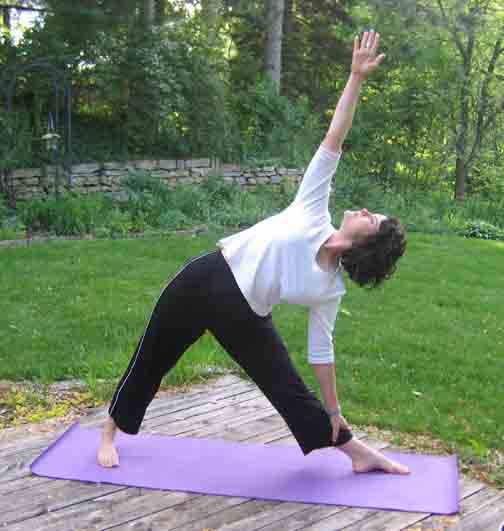
My trick for getting an aligned Trikonasana
One instruction I borrowed from a Yoga Journal article is to do seated twists in three parts over three breaths. During the first exhale you focus on twisting the lower back ("twist the belly button toward the right knee"), which is a small twist but gets the student to think about the base. The second breath moves up to the rib cage ("twist the breast bone to face the right knee"). The third breath is for twisting the shoulders. You can add a twist to the neck, at that point, if you like. This approach keeps the focus moving up the spine from the least flexible part of the spine--the lumbar--to the most flexible--the cervical. It makes for a much deeper twist, and a more thorough one.
Actually,it is good in any pose that includes a twist, not just seated poses, because it keeps the student's awareness in the spine and that extra length allows them to really lift the side ribs and work the muscles of the back. It also prevents them from just twisting at the neck and shoulders, so the whole back benefits from the pose. If you are doing a forward bend, it helps deepen the bend because the spine stays long and opens up space at the hip joint.
When you apply it to Trikonasana (Triangle), not only does it help the student think about lengthening the spine and opening the chest, but it also seems to stabilize the pelvis, so the hips open, too. Very rarely do I need to remind people to roll the back thigh out or keep the back hip lifted to prevent the pelvis from tipping forward, which is so common. It seems like a really cool trick, since I'm not even mentioning the legs. It is especially effective towards the end of class if we've been focusing on doing twists this way.
So, now it's your turn. What reminders or suggestions to find to be most effective? I'm all for some new ideas for spring (it's almost spring, right?)!
Friday, February 29, 2008
Reconsidering the Wrists
I was cruising around to various yoga blogs this evening, looking for inspiration for this week's post. I'm trying to visit everyone regularly (new Xmas laptop does wonders for the screen time) and see what's going on. There's so much out there these days; it's exciting to see how each blog deals with the subject differently. Namaste from Duluth had an extensive discussion of Down Dog, that got me thinking about one of my favorite instructions for that pose.
 I thought I had talked about this before in an earlier post on wrists, but after a leisurely scroll down memory lane, I realized I hadn't. My teacher used to instruct us to place our hands so that the wrist crease was parallel to the top edge of the mat to prevent the elbows from hyper-extending. I never realized why that helped until I did the reading for that earlier post. By lining the wrists up, you "square" the insertions of the radius and ulna of the lower arm. When they are crossed (elbow creases thrust forward) the elbows lock and you end up holding the pose by resting the bones against each other, instead of using the muscles of the chest. Sort of the same logic behind engaging the thigh muscles in Trikonasa or Virabhadrasana II so that the knees don't lock and make the pose rigid.
Give it a try for either Urdhva or Adho Mukha Svanasana, various arm balances or Plank. It is much harder to hold these poses when the bones are un-locked; therefore strengthening the pectorals and biceps (which is gentler on the wrists).
I think my students often wonder why so much time is spent arranging the hands and arms for Dog. But once they are up, they notice the difference in the work of the torso (I hope) and it gives them a focus for the arms. I've also been sliding a rolled blanket under their heels if they are quite far off the floor to give them some support so they can lengthen behind the knees...but that is a discussion for another post.
P.S. I highly advise a glance at old posts. Like flipping thru a photo album, it's fun to reminisce about what inspired a certain article or what you were thinking when you had to rant (or rave). I wrote my 100th post a few weeks ago and forgot to commemorate it...looking back is an acknowledgement of all that work. Whew.
Saturday, February 23, 2008
Some more Excellence
Oh yeah, I still have to finish my E for Excellence list. Here it is:
Yoga Like Salt
Yoga Dogs and Chocolate
Everyday Yogini
E for Enjoy!
Yoga Like Salt
Yoga Dogs and Chocolate
Everyday Yogini
E for Enjoy!
Friday, February 22, 2008
Yoga of Motherhood
When I was pregnant I thought a lot about yoga beyond asana, especially in the final trimester when my practice was mostly Baddha Konasana and pranayama. Frankly, asana is the easy part. Once you start to realize the opportunities for greater awareness and appreciation in the activities of your every day life (Yoga of Teaching, Yoga of Blogging, etc), you realize almost everything can become a practice if you decide to be engaged and respectful. It certainly makes everything count (see Jon Kabat-Zinn's practice of Mindfulness).
 I have two sons, 3 1/2 years and 6 months old. They are the loves of my life (after their dad) and--I'll tell ya--the hardest yoga exercise I've ever done. There is so much about motherhood that you have to practice vairagya (non-attachment) with, but one of the biggest things you have to let go of is your feelings about time. Everything is going too fast or not going fast enough.
 I have two sons, 3 1/2 years and 6 months old. They are the loves of my life (after their dad) and--I'll tell ya--the hardest yoga exercise I've ever done. There is so much about motherhood that you have to practice vairagya (non-attachment) with, but one of the biggest things you have to let go of is your feelings about time. Everything is going too fast or not going fast enough.
The baby is about to retire his car seat-basket and move into an upright chair--no more grocery shopping or going out for lunch while he sleeps. And he just had his first bite of sweet potato tonite. So I get excited to see him turn into a little kid and sit up straight and use a spoon. But I get wistful when I clean off the old car seat and get ready to put it away forever or imagine the day when breast milk is no longer his main source of nutrition. I can't wait until he sleeps through the nite (oh Lord, I can't wait), but I love letting him nap in my lap.
I felt much the same way with his older brother, although I was pretty sure I would get a second chance to celebrate all these developmental milestones with kid #2.
So I try to enjoy the process as it unfolds and not wish away any of difficult parts of their childhood. Or mourn the passing of the sweet babyish habits that fade with each new month. It is very hard and challenging but, as I've been saying, I'm not dead yet so I must be stronger.
In retrospect, Side-Plank, never seemed easier.
Wednesday, February 13, 2008
Russian Ballet Teacher
A few posts ago, jensmith98, asked for some thoughts about teaching a non-prenatal class while pregnant. Well, I have some thoughts so I'm gonna share them...
I taught through most of both pregnancies (stopping at the beginning of the 7th month for Eamonn, at the end of the 8th month for Alec). Because I teach an Iyengar-inspired style, it wasn't too hard to lead the class, with some minor modifications to lying-down poses to avoid pressure on the inferior vena cava (the large vein that carries de-oxygenated blood from the lower body--i.e.uterus--to the heart) To modify these, I used a bolster for Supta Padangusthasana (Hand-to-Big-Toe), Supta Baddha Konasana (Reclined Bound Angle), and Viparita Karani (Legs-up-the-Wall), so I was reclined at about a 30-degree angle. I usually just led the final relaxation verbally, while seated, altho a few times I did recline on my left side with supports.
I avoided most inversions and all backbends and front-lying poses. I did Adho Mukha Svanasana (Down Dog) pretty late into the pregnancy, altho after awhile it just didn't feel very good, so I did a Half Dog, with my hands on a chair or countertop (which felt great to shift the weight off my lower abdominals and lower back).
As I got bigger, I stopped doing demos and had more experienced students show the correct form. It also allowed me to show adjustments on them, so that the rest of the class could see better positioning for the pose. By the eighth month I stopped waddling around the classroom and did most of my adjustments verbally. I joked that I was going to teach like a old Russian ballet teacher--seated in a chair at the front of the room, tapping students with my cane when they were in the wrong position.
Most of all, I tried to be respectful of what my body was telling me as far as what I could and couldn't do. A lot of poses felt just fine, other stuff just felt weird. I felt a little silly parking in a chair at the front of the room part of the time, but it took so much effort to get on and off the floor that it was easier to do my perambulations from a seat. I hope I was a good example to my students as far as recognizing my limitations and working with them, rather than pretending they didn't exist (impossible to do when you are big as a house, I might add).
My own practice became much less physical towards the end, but I think the time I spent in Supta Baddha Konasana focusing on my breath really helped when it came time for labor and delivery (I only had to push for about 7 min.s, when Alec was born); I could really focus and stay calm despite the pain and how weird the whole process is.I was lucky in that both pregnancies were very low-maintenance, so I could keep up with my yoga. I'm glad I was able to stay involved with my classes and students for so long, because I think it kept me from focusing too much on the discomfort of the third trimester. Once I got used to my bulk (sort of), it was kind of fun to be the representative Pregnant Yogi.
So, it worked for me and I don't think my students minded the change in teaching style. At least my classes stayed the same size and everyone came back after my maternity leave. My message to jensmith98 is: teach for as long as you can, find the ability to laugh at your limitations and enjoy the attention. I loved teaching pregnant and I think the lesson of listening to your body is good for all of us, not just the mommies.
Those of you that taught during your pregnancies...do you have anything to add, suggest?
Friday, February 08, 2008
E is for Excellent
Yoga Mama has sent out a challenge of sorts...name your top 10 favorite blogs, and they--in turn--have to name theirs. Sort of a blogo-chain letter. I have been meaning to acknowledge a number of blogs that I like and bloggers who have made some interesting comments on GTTSB, so here's my opportunity. Here's my list so far,in no particular order...I have two more to go, but I also have to hit they hay if I want to get any sleep before the first feed of the nite. Ah, the baby trumps yoga (and blogging) as usual...
-YogaPulse
-YogaPulse
-Just Breathe
-Yoga and Cupcakes
-Yoga Dawg
Friday, February 01, 2008
A Woman's Intuition
So, the research continues. I had a really interesting conversation with Judith Lasater on Wednesday for this prenatal yoga series I'm writing. She has always been one of my yoga heroes--physical therapist, religion Ph.D, smart, sensible, good writer--so I was excited about the prospect of our conversation. Unfortunately, I was a bit tongue-tied, as well. I had come up with a few prenatal questions (appropriate poses for which trimester, etc), but, as we talked, I realized they were woefully basic and didn't take advantage of her expertise.
Luckily, Judith didn't let the interview peter out and offered her own approach to the subject. Of the many things we talked about (the yogic tradition and its lack of prenatal tradition, learning to relax, learning to teach relaxing), one of my favorite was acknowledging one's intution and learning to trust it. What a simple but complex idea!
How do you teach some one to trust the work that their body is doing and that it will provide you (your mind?) and the baby with the support it needs when the time comes? How do you teach some one to relinquish control, while allowing her body to do the heavy lifting? Judith talked about letting students acknowledge their feelings while in a pose ("If you like it, stay longer. If it is uncomfortable, come out of it.") and letting them take charge of their own practice. It seems like a subject that needs its whole own article.
I'm also reading Gurmukh's Bountiful, Beautiful, Blissful book (I'm hoping to interview her, too), and this is a theme she comes back to over and over again, as well. It reminds me of my discussions about non-attachment (vairagya) for the Ego article this summer. Intriguing, crucial and very, very difficult to teach (and practice!).
So, tell me. How do you teach some one to trust herself and the power her body has. How do you teach yourself? It's definitely something I need to work on. I suppose it there's any practice that teaches you not to cling to things that don't matter, it's motherhood (my floors are mighty gritty these days)!
Wednesday, January 23, 2008
Yoga and The Belly
 Apparently, more than any other topic, the most popular questions on Yoga Journal's newsletter for teachers ("My Yoga Mentor") is how to deal with pregnant students in yoga class. So, my next series of articles for them will discuss how to make class as safe and useful as possible for pregnant yoginis. This is not to be a replacement for specific study of prenatal yoga, but more an introduction into key concerns and essential modifications.
On the one hand, it seems pretty basic--one article per trimester, describe useful poses, warn about contraindicated poses--but it also is kind of overwhelming. Where to start? Having just finished my second pregnancy (and having taught the whole way through), I feel pretty in tune to the limitations of the pregnant body. But, I have no idea what it feels like to wander into your first yoga class, 7 months pregnant, where everyone else is regulars and not pregnant. I feel like these are the students that the article should address, but--man--it seems like there are a lot of issues to cover. Any thoughts?
It is interesting how the practice shifts from asana to pranayama and meditation--at least it did for me. I'm going to interview the obstetric nurse who helped deliver both my sons and is now, coincidentally, one of my students. I'm really interested to hear what a professional thinks are the most useful elements of yoga for labor and delivery. Obviously breath and focus are important, but I suspect there is more.
So, I'm headed into the research part of the process and thought I would post my initial ideas to see what y'all think. So many of you are teachers and/or mothers with yoga experience, I'm sure you can give me some suggestions of what to consider (remember, I only have 750 words per article). I look forward to hearing from you!
(Boy, looking back at that picture from June...I gotta say, I do not miss those maternity fashions, that's for sure!)
Monday, January 14, 2008
Proprioception...
 Jane Brody had an interesting article in last week's NYT Science section on balance (Preserving a Fundamental Sense: Balance). It was mostly about what determines your sense of balace and some exercises to improve it(nothing about yoga, tho, hmph). She writes that there are three main sensory contributors to balance: vision, cilia in the inner ear, and proprioceptors on the bottom of the feet. These decline with age, but there are ways to maintain these elements through various balancing exercises.
I was intrigued by proprioceptors, since I had never heard of such of thing. According to Wikipedia it is "is a third distinct sensory modality that provides feedback solely on the status of the body internally. It is the sense that indicates whether the body is moving with required effort, as well as where the various parts of the body are located in relation to each other." Nerve receptors in the muscles send information to the brain so that it understands where the body is located in space without using visual information. This is how you can walk in the dark without falling over or, with a little practice, touch the tip of your nose with your index finger while your eyes are closed. Or type without looking at your fingers, or drive without seeing your feet on the pedals. Important stuff.
Like most motor skills, it is one that can be learned. So I thought I'd post a little exercise to bring awareness into the soles of the feet. Where you go from there is up to you...Vrksasana (Tree Pose), Garudasana (Eagle), Utthita Hasta Padangusthasana (Standing Hand-to-Big-Toe Pose). If you really want to challenge yourself, try them with your eyes closed!
Grounding Thru the Foot Bones
Stand in Tadasana (Mountain Pose). Lift all your toes at once, and feel the rest of the foot settle into your mat. Now lower just the big toes. Now lift the big toes and just lower the little toes. Now lower the big toes, but keep all the toes in between lifted. Is this easy or hard? You can help yourself a bit, by mimicking the actions of the toes with the fingers (I don't know why this helps, but it does). Now lower all toes, so that each one has its own space to settle and notice how much more solid your stance is.
I like to start all my standing poses with this exercise, just to get the feet grounded, but also to help make my toes more coordinated. I even try to drum my toes, little to big toe--one at a time--in imitation of my son. I notice my 3 1/2 year old has so much mobility in his toes, he could play the piano! I'm not looking to add more digits on the keyboard, but I suspect that drummable toes equals well-tuned proprioceptors.
Ankle and leg strength also play an important part in your ability to balance. But the sole of the foot is the starting point. Give it a try and see!
Tuesday, January 08, 2008
Still herding...
Happy New Year, all! I hope you rang it in with a group of dear ones. We hit the hay about 9:45pm and I noted the transition when I was up again to feed the babe at midnight. Ah the glamorous festivities of early motherhood. Altho, I can say I rang it in with my nearest and dearest...(champagne glass half full).
I hope you've had a chance to look at all the comments about the last post (Herding Cats), there are some really thoughtful responses. I'm still thinking about the subject--not obsessing, mind you--and I've had a couple of ideas. How about a general test that would be taken after you'd finished your training, wherever you studied--like the accounting or bar exam. It would cover general yoga knowlegde--maybe the same categories as the YA certification--and ought to include some sort of demonstration of your teaching abilities (adjustments, modification, general classroom manner, etc) that would be evaluated by a senior teacher. Instead of placing emphasis on where you studied, it would measure what you actually know and can teach.
This could be the basic Hatha test...if students wanted to continue on to a more advanced study of Iyengar, Ashtanga, Kripalu, etc., that could be an additional credential to the basic test. By creating a measurement that would assess everyone's skills evenly, I think it would more fairly identify who should be teaching and who shouldn't. And, I suppose, you wouldn't have to take the test to teach, but any organization that wanted to be assured of your expertise could require it.
It's a huge undertaking, of course. What would be on the test? Who would score it? What would be the criteria for assessing the teaching demonstration? Where would it happen? How often? What is required for a passing "grade"? etc. etc. On the other hand, maybe there needs to be something this standardized to help level the playing field of all the different trainings. Instead of trying to cobble together something from lots of disparate sources, you could just say you passed the Hatha test with flying colors.
I, for one, would be relieved to have something that measured my yoga knowledge and my ability to present it effectively. Assuming I would pass the test, of course...
Chew on that one for awhile, and let me know what you think!
Sunday, December 16, 2007
As Simple as Herding Cats
I'm in the process of applying for another teaching gig at a new "wellness center" that has opened in the Stateline area. It's affiliated with Beloit Memorial Hospital and has a whole wing with doctors' offices and physical therapy, in addition to a very swank gym, pool and studios (Pilates and yoga have separate rooms). There will be some overlap from my students at the Y, but also a lot of new folks from Northern Illinois.
I've hit a snag. Because of the medical aspect, they want to make sure all the instructors are well-trained and certified. The certified part works well for the aerobics teaching and trainers, because of the rigor with which ACE, etc. keeps track of their teachers. They are having some trouble with the yoga teachers' credentials, tho--especially me.
I had a very intense training period with my teacher in DC and spent every other Saturday for a year at her house studying poses--how to teach, how to modify, how to sequence them. I also did some (not a lot) of student teaching at her studio and she observed some of my teaching. So, I think I had a good grounding (ha) in the basics and have tried to stay current with various workshops, etc. when I can get to Madison or other yoga conferences. For what it's worth, my students seem to be happy with my teaching. But none of this is work towards a specific Certification...and none of it is with Yoga Alliance members (altho I have studied with Iyengar, Kripalu, Ashtanga, etc. teachers), so I can't count towards a R.Y.T. designation. There are 5 YA-approved schools in Wisconsin and the nearest one to me is in Milwaukee (80 min. drive each way), so I can't really start over from scratch.
It's made me think about yoga teacher training in this country and how to organize (if that's possible) all the different styles and approaches so that outsiders can measure how qualified a teacher is. This is a huge debate in the yoga community--and while the Yoga Alliance has the right idea--I'm not sure it's possible to gather all of us under one governing body. And maybe we don't want one governing body, but how to assess the quality of different trainings? And is teaching yoga in a multi-purpose facility, such as a gym, less legitimate than in a studio? And consider the possibility of including yoga in a wellness plan that insurance companies would be willing to support, how would they measure its effectiveness? How about those of us who practice and teach in communities without a large yoga network?
I'm not sure how it will go with North Pointe (the aforementioned wellness center). I hope I can cobble together a resume that they approve of, but we'll see. In the mean time, what do all of you think of this subject and how have you dealt with the issue of multiple trainings/quality of trainings/lack of certification/etc? Any ideas?
How do you herd a group of cats and keep them in the corral...
Monday, December 03, 2007
Don't Think, Just Do...Parivritta Janu Sirsasana
In the interest of maintaining some sort of home practice, I'm going to put up a single pose each week for you (and me!) to drop into. Preferably there would be some sort of lead-in and some sort of follow-up, but 5-10 mins. of yoga is better than nothing at all. I'm not advocating headstands without any warm-up, obviously, but most of the standard poses will still give you a nice stretch in the moment. Maybe some time, in the not too distant future, I can have my own practice, again. Sigh.

Parivritta Janu Sirsasana (Revolved Head-to-Knee Pose)
1 . Begin in Dandasana (Staff Pose) with the spine long and aligned. Then slide the left knee to the side and, using both hands, gently roll the shin and top of the foot towards the floor. Try and line your heel up with the center of your perineum, but don’t loose the length in the lower back. Extend the left leg to the side so that your legs make a 90-degree angle. Keep the left big toe and knee pointed towards the ceiling.
2. Sit tall and concentrate on lifting the side ribs and lining the shoulders up with the hips. Start twisting to the right (towards the bent knee), concentrating the twist in the lumbar spine.
Subscribe to:
Posts (Atom)

